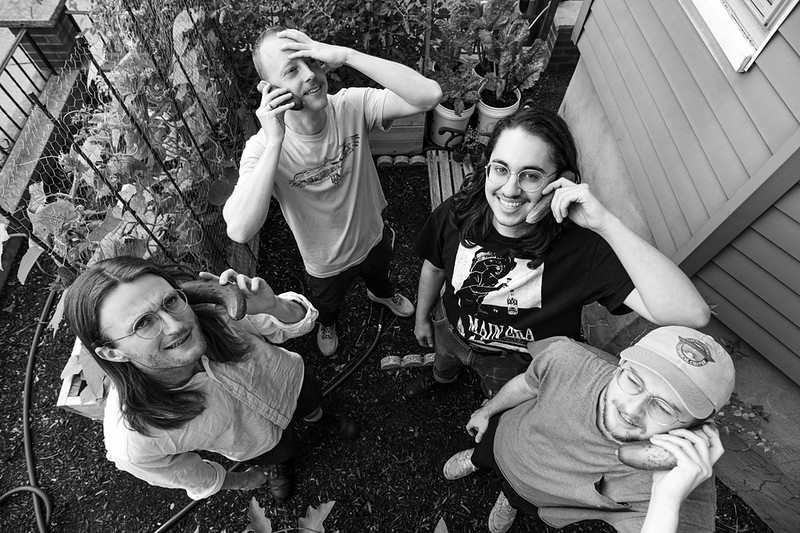
Boston indie rockers Clifford dropped “The Band” and started getting serious. Well, they’ve always been serious about the music, but nearly two years into the process of putting together their debut LP Golden Caravan, it’s clear that the four-piece means business. Seeking to drive a through-line between the terse, nervy post-punk and the freer flowing folkisms on which they’ve built the brand, this record feels both like a culmination to those who’ve been paying attention, and perhaps a proper introduction to the as-yet uniniated. Out today on Sipsman, it will surely stand among the finest collections of rock music you’ll hear out of Boston (or even the country) this year. We sat down with Clifford a few days ago to chop it up and snap a few pictures in the garden, so hit play on the stream, and please do indulge us below.
Allston Pudding: So this album has been in the chamber for a while, what took so long?
Miles Chandler: Well we all have jobs, and life gets in the way as does perfectionism. Recording it took a really long time, probably around a year.
Nate Scaringi: It’s been a year since it’s been done though.
Miles: Maybe on previous releases we’ve sacrificed some things for expediency, but this time we strived to do the best we all could given our collective capacity to do stuff, which took a little longer. We went for quality this time.
Nate: I don’t remember any gaps where we stopped making progress, like it was pretty consistent and that was how it was always going to be. It was a slow, incremental pace and a lot of that was based on our ability to use The Record Co. space just one day a week when we had access. We also made this record for free, which was huge. I work over there so I had access to the space, and Mondays are “staff days” so we’d go over there and chip away it every possible Monday that we could, typically breaking it up into “drum” or “guitar” days, squeezing in vocals in bits and bops as time allowed. That took a little over a year.
Miles: The process of shopping it around was a little convoluted as well. We we’re quite sure what we wanted out of a label, since we’re kind of in a twilight zone between not wanting to sacrifice any professionalism and not really having the time to a real full-time band. PLus, touring consistently has never really been in the picture, so we needed a very specific sort of institutional backing to pull it off. Self-releasing was definitely on the table, but we reached out to a bunch of smaller indie labels, all of whom either didn’t have a lot of capacity or were backed up. Then randomly we got an email frome Mike (Caulo) of Sipsman (e.d. what’s up Mike) which was kind of terrifyingly coincidental as he had been working with a different group we’d played a show with and had access to their email and our album was in their inbox and he found it, played it, and really liked it. Mike sort of advised for a while about label shopping before we mutually felt like it was a really good fit for him to put it out on his own label.
AP: How much have the songs changed in the time since they were initially written?
Nate: Not a whole lot. There was some stuff where we’d go in and conduct ourselves differently within parts, but the arrangements haven’t changed much, but our playing may have a little. I know my bass parts have change a bit over time, but they’re still pretty true to form. And you know you play shows and you play new songs and they change over time, slowly but surely and then you listen to a demo from over two years ago and it doesn’t sound anything like the song anymore.
Ben Curell: I feel like there were several songs on the album that we were just learning how to play as we recorded them, so consequentially they felt a little less comfortable in the studio versus now when we’ve performed them a bunch. I remember “Gifthorse” in particular feeling that way on drums, it was towards the end of a session and we only had about 20 minutes left to get something on tape, so I was just like “let me take a shot at this” and well, that’s the drum part on the record.
Miles: The tones are excellent, though.
Nate: Same thing happened with “Golden Caravan” too if I remember correctly. We had recorded drums for the song, but everything else just wasn’t cutting it, so we redid the guitars and bass a lot to shift it into place.
Danny Edlin: But that’s about as dramatic as it got. We definitely are more of a “parts” band than the average. I feel like we are really trying to execute something with our recordings and we have that fairly planned out.
AP: I feel like a big theme in this record is about being present in whatever it is you’re doing. Do you feel like that is reflected in your playing as well?
Miles: Totally. I like thinking of the riff as something for the body, chords for the heart, and lyrics for the soul. I think that’s a nice hierachy to set up. The riff being for the body is so fundamental, There’s something about like plugging in a guitar really loudly and just playing a really harmonious riff really well. I think that’s like that’s kind of what keeps me doing this. And that’s very much about being present.
Danny: eah, I think an overlapping part of all of our musicianship is like liking when something isn’t just challenging for the sake of being challenging, but having a part that is challenging for a purpose. To me that can be a great way to access a present state of mind because it it takes all of your attention, and I think a nice thing about playing this music is that it demands your attention to play it.
AP: Another theme that I think comes up in the lyrics is gentrification and displacement. How do these things sort of play into and affect an arts community?
Miles: I think structural violence is something I was like chewing on a lot in the thematic content of this album. Ben and I were tenants at the Sound Museum in Allston and that was like a really protracted affair when it got torn down. I think Ben was a longer time resident so he can speak to that.
Ben: Yeah that kind of coincided with the whole recording of this album. So we’re trying to piece together this record while simultaneously getting moved around to different spots in Boston just trying to find a place to practice, which was especially a pain in the ass for me as a drummer. Because the Sound Museum got demolished in 2023, and then we moved to 55 Morrissey in Dorchester which was a massive pain in the ass to get to as everyone can attest to.
Nate: Yeah I dunno it took me 10 minutes to get there.
Ben: Obviously there were a lot worse things going on in the world, but it felt a lot harder to pursue our crafts in Boston and be able to like practice regularly. Now luckily we have Danny’s basement so a lot of that’s been solved.
Danny: It’s crazy. The basement setup I have at my house, I feel like maybe six bands regularly rely on it for practice. It’s just a huge need.
AP: What is a golden caravan? Is it an actual thing? What is sort of its significance and influence on the music and the album?
Miles: That’s a question I’ve never asked myself.
Nate: I kind of imagined it as this hulking, gilded thing that doesn’t really have any brakes that is just careening towards something awful. Yeah, it’s kind of like a…it’s very much a metaphor for America.
Miles: It’s like the gravy train, right? Except you can’t necessarily get off and nobody is driving it. It’s definitely symbolic of excesses and wealth, and this unbounded ambition towards excess that so many people don’t really ever achieve. It’s not an attainable goal. Or a sustainable goal. And it’s a pretty image, which is also important.
AP: Your music thus far has kind of shifted between more visceral, heavier stuff, and softer, more folky material. What draws you to either, and how do you sort of decide what mode in which you’re going to write a Clifford song?
Miles: Well, ideally there’s not just two kinds of Clifford songs. I think maybe there’s two poles because those two sounds are very far apart, but I also think maybe my favorite thing about this record is it gets closest to my goal of combining those sounds in a way that’s functionally a new thing, or its own thing. I think I started doing that because I grew up both as a punk, like I got American Idiot for my sixth birthday and played it until like my parents ears were bleeding and refused to play it in the car anymore. But I also grew up on Lucinda Williams and Hank Williams and the classics of Outlaw Country and also the Grateful Dead. There was a lot of twang circulating in the house as well, is what I mean, and I think those things maybe scratch different itches, or I’m writing songs with different emotional affects will fit better into one sort of box than another. But you know we’re all complex emotional beings and I think trying to trying to blend those things together is a really fun project. It kinda seems like something that a lot of people are trying to do these days.
Danny: Something I think about when I’m playing this kind of music on guitar is that the musical language is very similar across those styles, like the micro-techniques required to play math rock are very similar to Neil Young licks. It’s a lot of open strings, it’s a lot of pull-offs, it’s a lot of hammer-ons, and that comes out in older songs of ours like “White Hat” and “Fistfight”, and it comes out on the new record, too. I think it’s also just a part of Miles’ particular guitar language, too, and it’s bound to rub off on all of us.
Miles: “White Hat” is a funny thing to bring up, that song, to me at least, I play it like a fucking bluegrass flat-picking song, and it’s very much about right hand technique on the guitar, almost like, you know, maple leaf rag or some shit. The genres really aren’t that far apart technique-wise.
Ben: Even like country-style drumming, there’s a lot of, well obviously, the dynamic level is a lot lower, but I think there are a lot of parallels there.
Miles: If you look at the history of those players, Johnny Cash was punk as fuck. A lot of those people were way more outlaw than the people we consider to be punks, and they just maybe cleaned up for the day, or for the performance. So yeah, both are quintessential parts of the Americana tradition. There’s a record label out of Chicago called Bloodshot that I grew up listening to a lot, and they’ve been like keeping that ethos alive for a long time.
AP: Every time we see this band it’s a different show (in a good way). What goes into deciding what kind of Clifford show is going to happen on any given night?
Ben: Other bands on the bill for sure. As Nate describes often, we kind of have a Jekyll-and-Hyde situation, or we have historically at least, where we have our louder, more metal-leaning progressive rock stuff, and then the chiller, folkier stuff. We usually cater the balance of those two sectors of songs to what the other bands on the bill are like.
Miles: Also I think it’s about the bill, for sure, because, as a performer or as an opener, you’re showing up to support. Supporting is a functional verb that I take very seriously. I want a night to go cohesively, unless there’s like an explicit reason to make it not go cohesively, which is also fun sometimes. you also have to think about the room you’re playing in. Like if you’re playing a big concrete box, then playing super loud is not going to translate really well, so it might be a nice night to play some of the more ambient, echoey stuff. It’s also sometimes based on what mood we’re in. Sometimes you don’t really have the energy to, you know, throw hands, or like get really active on stage. That might be a good night to play some more soulful songs in response to the emotional state you’re in.
Danny: Pragmatically, it’s like what songs do we have ready to go? Especially if it’s been a while since we’ve played. We do have certain songs that we never need to practice that are always ready to go and there are a couple of those always in the mix to make us all feel a little more relaxed on stage. What’s been nice about getting the album ready for our upcoming tour is that the whole album is ready to go live and so that gives us a lot to choose from for the set.
Ben: One of the great things about this album, in my opinion, is there’s a lot of tunes on it that do bridge that gap effectively, which is something we’ve been aspiring to do to keep our catalog a little more cohesive. I think Spirit Was was a big influence on this album, with the country and doom metal synthesis helped a lot in terms of us presenting both sides of Clifford in a single package.
AP: What inspires you all as musicians?
Miles: I grew up as an Audioree kid in high school, finding indie rock, and especially local indie rock, and the people who were just barely getting some recognition through media, at least enough so that a kid sitting in his living room could watch YouTube videos of them. I think those groups were really core to me developing my identity, and so I hold that culture very near and dear, because it did so much for me and has done so much for me, so now it’s really fun to contribute back to it. If you’re pulling water out of the well, you should put some back in It’s cool now being at a point where like we’ve come to know some of those folks that inspired me. I was a huge Ovlov head, and I feel like a lot of the bands that came out of the Boston music scene and the DIY scene in the Northeast when around the 2010s were like really influential for me. So getting to know some of those people and then having like them give us the thumbs up feels really good. That deep sense of community I think is really redeeming.
Nate: Yeah, the community aspect is really big. I also think just playing is so endlessly rewarding that that’s enough for me, personally, just because I do a lot of it. I try to do it any chance I get. So, you know, playing, combined with having friends around knowing like “oh we’re gonna tour through these cities and we’re gonna see these people and play with these bands” continuously comes back to being the most rewarding and and inspiring thing about what we do.
Ben: One of the things that inspires me most as a musician and as a listener is being able to hear amusician’ signature imprint, or their personality come through on the part they’re playing on a given recording. That organic quality of being able to say “that sounds like a nasty Nate bass part” on “Inkblot” both from the actual execution of the part, and the tones that are coming out as well. That’s one of the coolest parts about music in my opinion, getting to hear everyone’s personality in a given song within their individual parts.
AP: What does the Boston music scene mean to you?
Nate: It’s the petri dish because it’s stinky! It smells like shit! No I mean it’s because Boston is small, and most people know each other, and I think a thing that I think ends up drawing a lot of criticism is that it’s so segmented, but I really like that there’s so much different stuff that you can go see. One night you can go here and see an indie rock show, and then the other night you can go there and see a hardcore show, and then the next night you can go to a really weird rave in a basement, and that’s awesome. Those shows will all be within two miles of each other and you’ll end up seeing some of the same people at a lot of those different shows, and it’s taught me how to be in a community like this, and the etiquette, and how to support your friends and the people around you. It feels good to be an active and contributing community member in a place that is pretty, on the grand scheme of things, isolated from the rest of the country being up in the northeast.
Ben: The DIY scene and the experiences I’ve had in basements of these various famous DIY venues in Allston and Brighton, that’s what really encapsulated my experience in the Boston music scene. I feel like there’s just this resilience baked in, too. I’ve been in Boston since 2019 when there was a whole different slew of house show venues pre-Covid and then everything obviously got shut down, but then a whole bunch of new venues kind of like blossomed up as a result. Even my old house on Ashford Street once had a stage down there. It’s just the phenomenon of these DIY venues, like they inevitably get shut down, but then new ones always seem to crop up. Also, as we get older, seeing the rotating cast of people showing up to these shows, there’s always a new influx, or a new generation of kids in these basements and that’s inspiring. Boston’s obviously a revolving door for a lot of students, but seeing the next generations of people also getting to experience the DIY scene and knowing that the cycle is just going to continue in perpetuity in some degree? That is very inspiring for me.
Danny: I think we all cherish this scene, and it’s a little bit different for all of us, and to everyone else. One thing I find special about the Boston scene from my limited sense of other music communities, is that it’s just a tiny bit of a higher bar, partly as a result of Berklee kids being everywhere. The level of musicianship is high around here. I remember when I started going to shows around here, maybe it was because I hadn’t been to a lot of different kinds of shows, or just the kinds of bills we were on, and just thinking “the average band here is really fucking good.” I’m not trying to be shooting for Berkee kids or whatever, but I think we do take for granted that you can just go to a basement show and people are fucking shredding. I don’t really glorify all that, but I’d rather have that kind of proficiency around than not, I guess.
Miles: There’s infinite layers to peel back, like at this point Idon’t know what the fuck’s happening in the house scene in Allston anymore because I’ve lived away from there for two years, and it does turn over so much. And the cops are on people’s asses, but it’s not like people are going to stop making music. They’re going to find some fucked up corner of a basement or something to go be loud in and be productively violent and joyous, and I think that’s sick. I grew up in Syracuse and the music scene there was a lot angrier, a lot more violent, and a lot less safe than what I see here. I’m sure you can find that here.
Nate: Haven’t been to the right shows, brother.
Miles: That was really eye-opening when I got here. There are a lot of people that are really talented at music and studying it because of that, but the proficiency that gets me excited is the types who will go to a show and pick up on something and then go home to their own pen and as part of their own personal art practice create something exciting. Even if it’s just a hobby or a side gig or something. I think the excellence bleeds far beyond the conservatory folks. I think they’re inspiring and they keep other people sharp, and they also make a bunch of weird noise that is interesting to experience. But then that’s just one element of this ecosystem. I guess I was sort of expecting to move to Boston and have, like, a billion Dropkick Murphys spinoff bands playing in shitty bars. I’m sure that’s there is that if you want it, but that’s definitely not what I think of now. For a city of its size, Boston definitely punches above its weight in terms of diversity and cutting-edgeness of what’s coming out of it.
Check out the rest of Harry’s portraits below:

Golden Caravan is out now. Grab it on vinyl here.