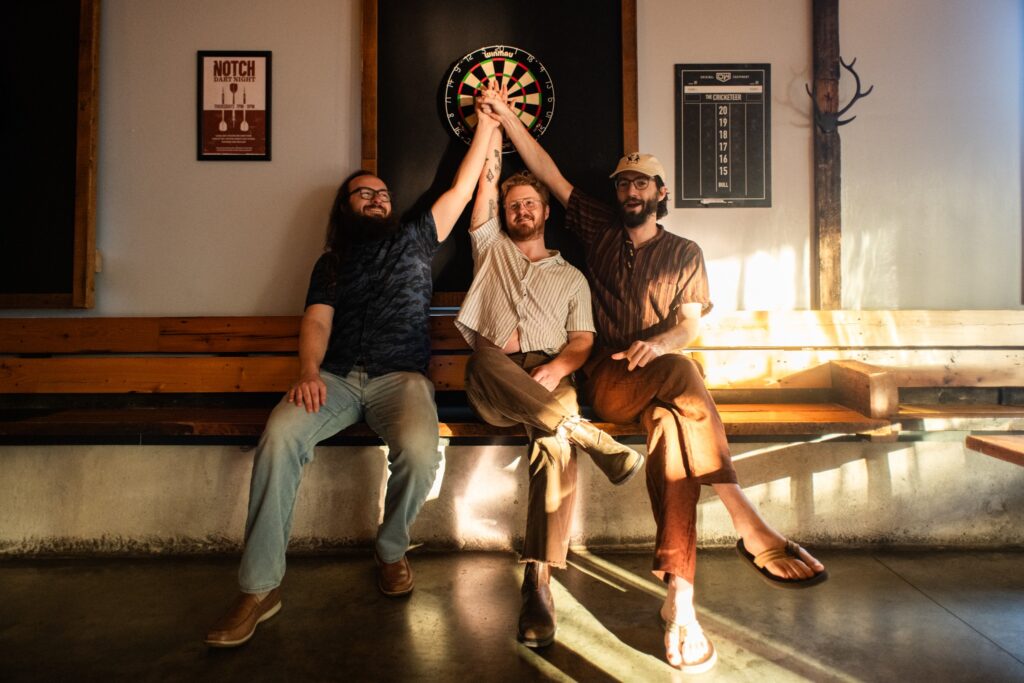
I first encountered Hound & Handler when I stumbled into a gig at Remnant Satellite in Cambridge a few months ago. What was immediately noticeable about the group’s sound was the tightness and mutual understanding that buoyed their vocal harmonies. I grabbed my roommate’s arm as the trio dove into the opening arpeggio of “The Sweater Song” off Weezer’s Blue (early Weezer always excites me).
Fast forward a couple of months and I’m pulling up to Notch Brewing at the Speedway in Brighton, where the members of H&H are waiting for me outside at one of the long tables. It’s a beautiful afternoon in late Spring. Spirits rise when the sun sets after 8PM.
The trio is made up of Sean Davis, Joe Everett, and Ross Kiah, who (approximately) play mandolin, bass, and guitar respectively, leaving plenty of room to wiggle around on other instruments when the time calls for it. They joke around about giving me the “full back of the LP credits” as they list all the multiple instruments they plucked around on for their latest EP, At What Cost, which debuted in June. “Joe plays the minivan, too” Kiah jokes around. But jokes aside, what’s a local three-piece band without their driver?
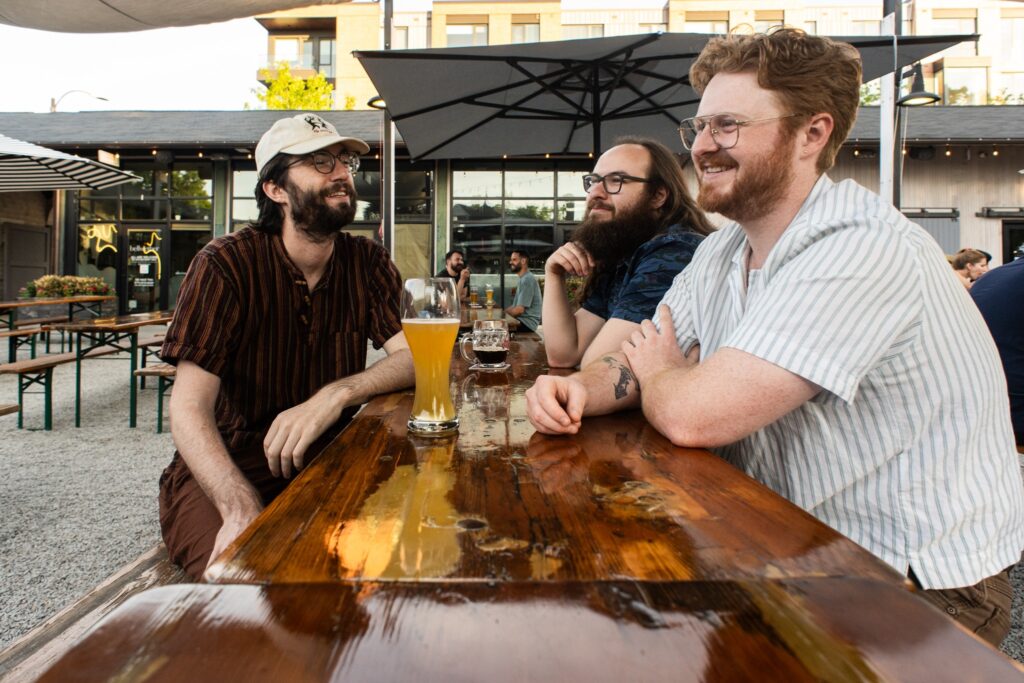
The band kicked off as a side project for all three members that offered the chance to do something different than the other bands that they hailed from. Bluegrass hadn’t been a huge part of their background as musicians beforehand. Everett was talking about jazz fusion when I first arrived at Notch and mentioned that he’s also started playing in a black metal band recently. Dabbling in genre is not off the mark for these lads.
While bluegrass often feels like a genre that harkens to the past, H&H’s lyrics find the band with firm feet on the ground in the present, and a keen eye on the inequities of the world. The EP’s title track reveals much about the band’s ethos, calling out American hypocrisies in a way that feels fresh among their peers. Perhaps that’s the band’s secret to making an older genre feel fresh: directness.“I tend not to take myself too serious,” Kiah sings on the track, “which I can do because I’m not in a country getting bombed and turned to sand, but it gets a little hard because my taxes build the bombs.” There is no metaphor or inflated sense of poeticism to muddy down the message, allowing the band to circumvent the stiffness of tradition.
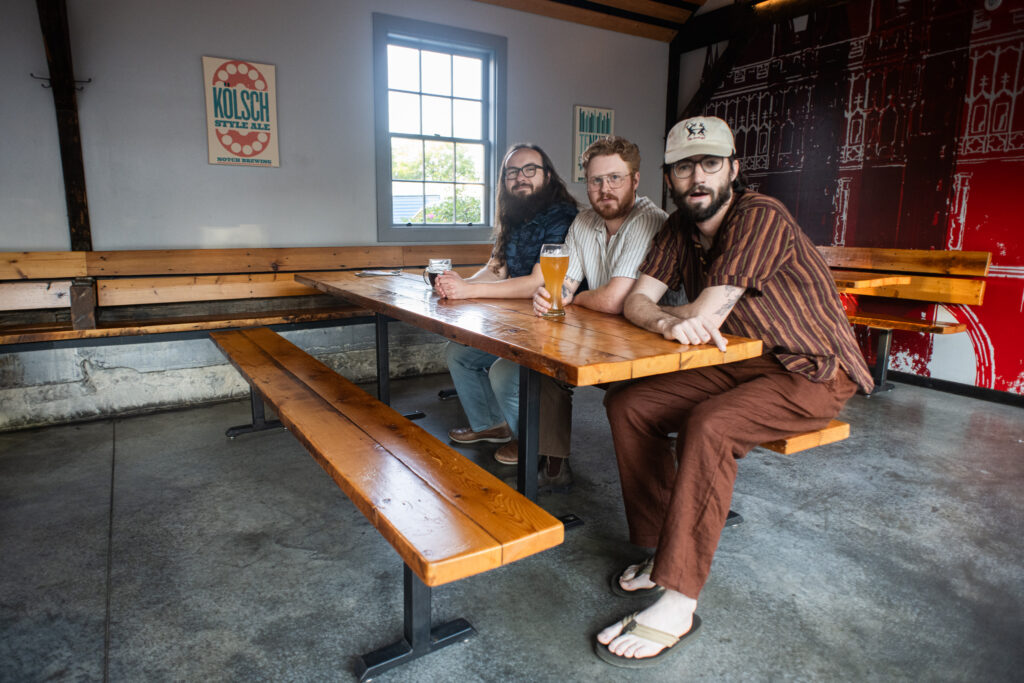
With that said, Bluegrass is nonetheless a genre that demands some degree of virtuosity. The genre is built on precise tempo changes, rapid-fire plucking, and tight vocal harmonies. The band members pushed themselves by joining community jams and getting a sense of the expectations at hand. “I was definitely a little intimidated at first to go to jams and talk to people,” says Davis. “It’s like the assumption is they all know more than I do. And it’s like I don’t wanna embarrass myself, but everybody has been so unbelievably kind.” They also find times to slow things down into pure tranquility, notably on their dreamy cover of the Glen Campbell country classic “Wichita Lineman.”
When recording, it’s important for the band to maintain some semblance of a live feel even in the studio. The bulk of these five songs were recorded with all three members in the room together. “We did most of it live except for the harmonies,” Kiah says. “I get nervous singing when I don’t have a guitar in my hands.” This direct approach allowed the band to record efficiently, with the EP only taking a day-and-a-half to lay down.
As we wrap the interview, I spy a photo booth in the far corner of Notch and have Hound & Handler pose for a strip by having them dip in-and-out individually for each shot. They made deft, rhythmic work of the task. Here’s the result:

Stream and purchase Hound & Handler’s latest EP At What Cost via bandcamp below.