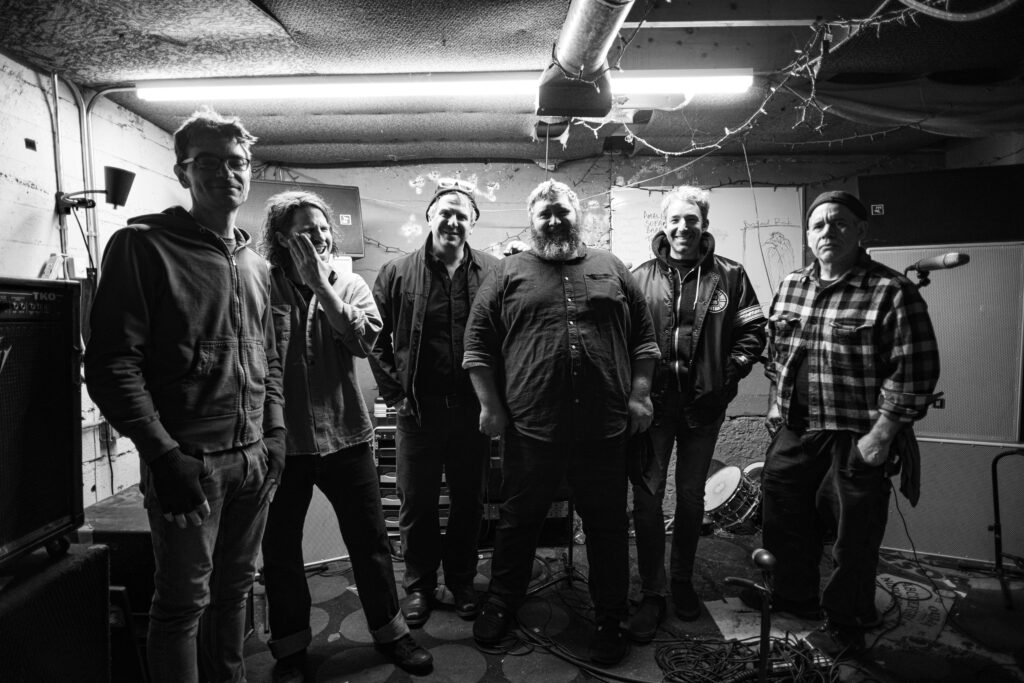
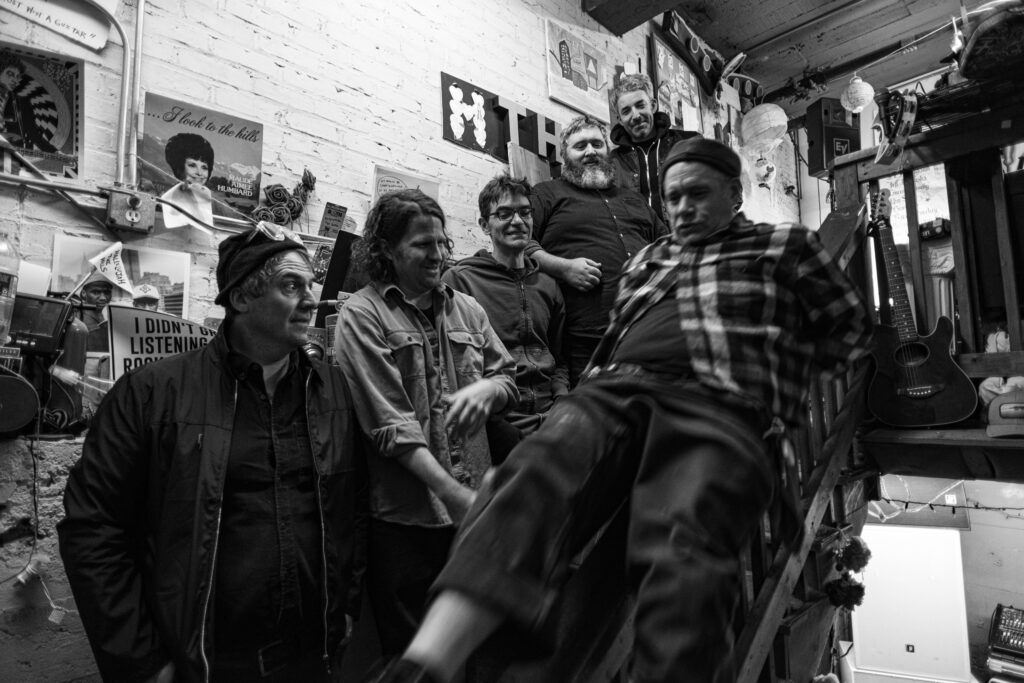
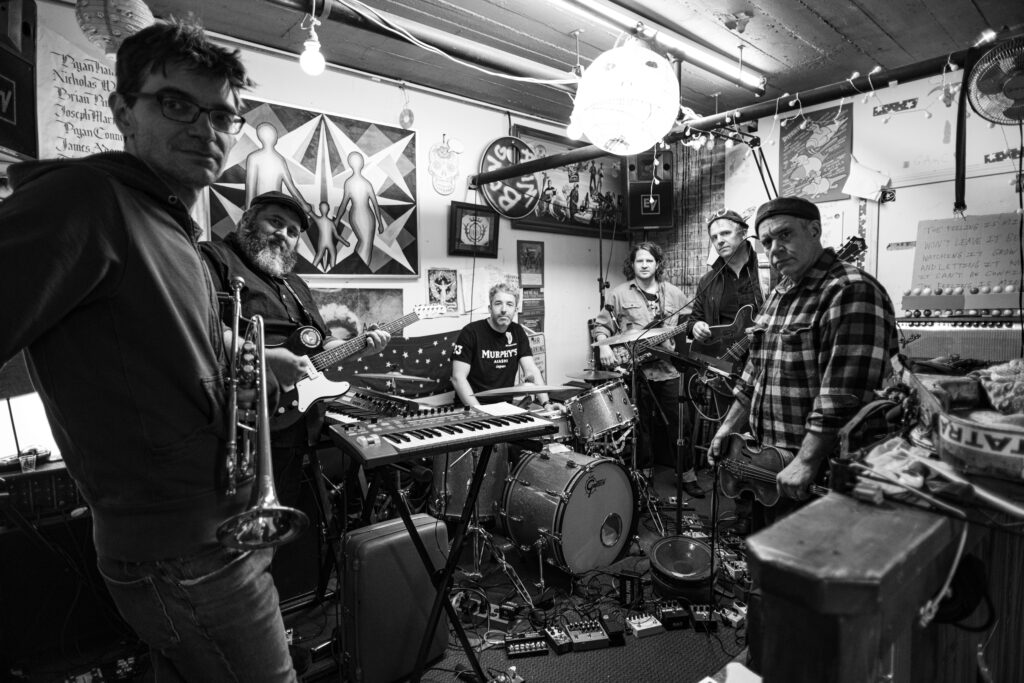
I don’t think I trust a band that rehearses in a clean, well-organized space. There’s a character to clutter. Look at the art studios of someone like Francis Bacon. So when I meet up with Ryan Walsh outside the Charlestown space where Hallelujah the Hills rehearses, I’m relieved when it’s glorious chaos. Gear everywhere, old furniture piled with past props, posters lining the walls (a blown up print of Jim Marshall’s iconic photo of Johnny Cash giving the finger during a performance at San Quentin Prison catches the eye).
For a band, 20 years of life feels like a century. For every group that hits the two decade milestone, there’s probably 50 that never made it out of their moms’ basements. While Hallelujah the Hills have mostly ironed out the kinks in the operation at this point, those first couple of years saw plenty of ups and downs, including inconsistent lineups, especially when it came to holding down a drummer. “We had someone quit onstage in the middle of a set,” bassist Nick Ward explains. “There’s a recording of it.”
The prescience of Spinal Tap aside, Hallelujah the Hills has been a pedestal of Boston’s indie scene since 2005, when Ryan Walsh was still playing in a group called the Stairs. While the name has caused some mild confusion (“There are people that think we’re a Christian band,” says Walsh), it’s stuck. For the better part of the last 15 years, the lineup has stayed consistent with Walsh (guitar/vocals), Nick Ward (bass/guitar/piano), Joe Marrett (bass/guitar/all sorts of things), Brian Rutledge (trumpet/trombone), Ryan Connelly (drums), and David Michael Curry (viola).
Walsh and Marrett smoke outside the rehearsal space while we wait for the rest of the band to pour in one-by-one. It’s early November, which means it’s dark at 6pm and just warm enough to not be too uncomfortable to be outside at night. They start taking me through the lore.
Over the years, they’ve picked up allies and collaborators from all over. This writer’s first awareness of the group came from their appearance on Titus Andronicus’ 2009 The Monitor, a punk-rock-opera rife with Civil War imagery. “We got paired together in Chicago,” Walsh explains. “It was like the first band we’ve been paired with on a tour that I just thought was amazing and loved. We became fast friends.”
Fast forward 20 years to the day of the first show that they performed at Great Scott, they’re celebrating the band’s birthday at Deep Cuts in Medford on November 15th.
Riding the coattails of their latest album Deck, which the band released this past summer, they’ll be performing a career-retrospective set. While Deck’s release show featured only songs from the recent release, the 20th anniversary will be a career-retrospective. Any album is fair game.
At 54 songs, Deck stands as the band’s largest work. And while a 54 track concept album might at first seem daunting, Walsh and co. did what they could to make it more digestible to listeners. First of all, it’s subdivided into four regular sized albums, each styled after one of the suits in a deck of cards. Each suit has a distinct mood (for example, Hearts is more on the romantic side).
The band also encourages listeners to participate in the album’s sequencing by offering a customizable option: grab a deck of playing cards, pulls 13 cards at random, a make a playlist with the Deck songs that correspond with those cards. Ten of Diamonds? That’s “Samantha, You’re the Only Mistake I Know How to Make.”
It seems simple, but as Walsh acutely points out, this playlist methodology means that listeners can craft an entirely unique and personalized album experience. According to Google, there are about 635 billion different combinations possible by using this method. Even if you pulled all the same cards as the next person, it’s highly unlikely that they’d be in the same order.
The idea for the album has been in the back of Walsh’s mind for at least as long as Hallelujah the Hills has been a band, but never really got around to. He assumed that by the time he’d get around to making it, someone else would already have done it. But when it came time for the band to write and record a follow-up to their 2019 album I’m You, Walsh pulled the concept off the shelf and ran with it.
There’s some other cool elements to the album, like the joker songs, which are two instrumental tracks that the band released into the public domain. This idea was to encourage listeners to record their own vocals over the tracks. Deck’s about interactivity, after all. “We wanted to do something big and ambitious,” Walsh says, “but also signal like, this is not a chore. However you engage with it is great in our opinion.” After he says, Ward arrives at the space and we move the talk inside. The rest of the band soon falls in.
Writing and recording a 54 track concept album demands a lot of yourself as a songwriter and of your fellow musicians. While no recording process is entirely smooth, this monumental endeavor didn’t weigh too much on the band. Walsh was productive, writing fervently in his downtime and delivering at least one new song to the band’s sessions each week. Once they had enough material that they could divide into four categories (13 songs per suit plus two jokers), Deck was ready in about two years. There are bands that take longer to produce less.
Deck also features collaborations from many of the friends they’ve picked up along the way. “Time to call in that favor from 13 years ago,” Walsh joked with Titus Andronicus frontman Patrick Stickles during the recording sessions. The band also enlisted help from Sad13 of Speedy Ortiz, Craig Finn of the Hold Steady, Clint Conley of Mission of Burma, Tanya Donnelly, Ezra Furman and more to round out the album’s cast.
While the response to the album has been positive, Ward does take a minute to grind his gears about one pet-peeve. “A lot of write-ups have called it a gimmick,” he says, laughing at the difficulty of recording 54 songs. “I feel like if you come up with a gimmick, it should have made things easier for you. If it made it harder, that signals you were trying to do something.”
Walsh adds that it’s more of a gimmick for bands to break up and get back together. “You get free press on it on each move when you quit and when you get back together,” he says. “So I think bands should quit, break up all the time, keep getting back together until no one will write about it.”
In all that time, songs are born and grow and change at almost the same rate as the folks who wrote them. Walsh looks back on some of the lyrics he wrote on the first couple albums with incredulity. “I feel like with a lot of your lyrics in the early days,” he says, “I didn’t really know what you’re singing about.” Looking back now, he has to create his own little meanings for what might have been running through his head 20 years ago.
At one point, as they’re setting up to rehearse, Walsh asks Ward how it feels to have been part of the group for the past 20 years. “Dude,” he replies, “it makes me feel old.”
Check out Hallelujah the Hills’ 20th anniversary show on Saturday 11/15 at Deep Cuts in Medford.