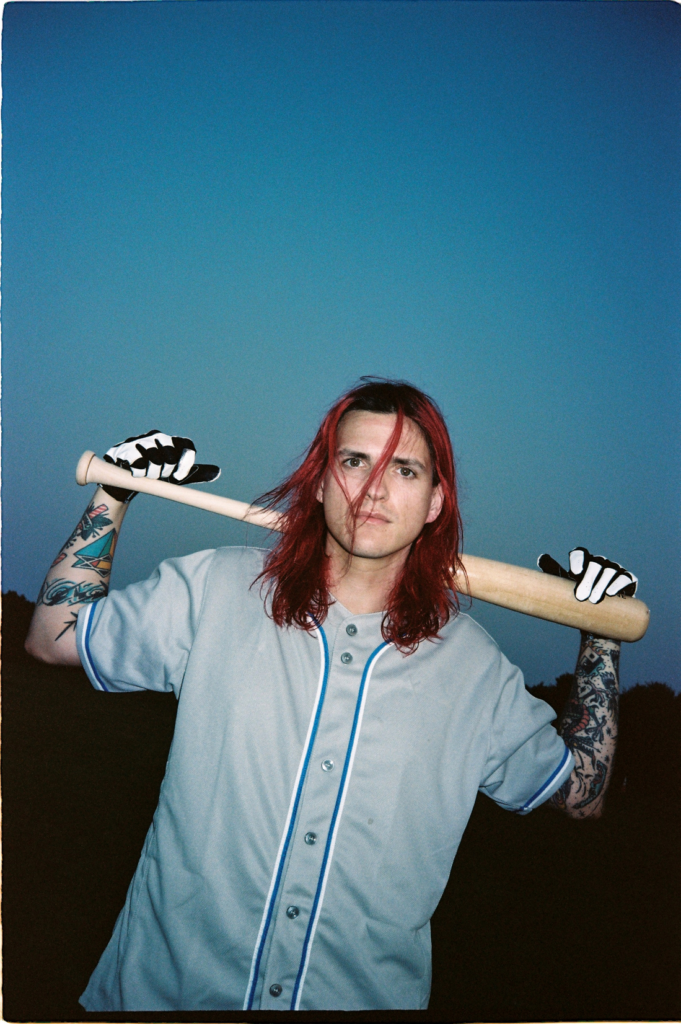
Opposite of what Karl Marx once wrote, Dirt Buyer began as farce and then as tragedy. Started by two Berklee kids as one in a series of genre-locked fake bands they were to collect into a compilation that secretly just featured themselves, Dirt Buyer was the blandest “New England emo band” name they could come up with. This did not happen. As the emo-folk tunes they recorded on an iPhone kept flowing, the duo of Joe Sutkowski and Ruben Radlauer instead issued a terse self-titled Dirt Buyer LP (originally under pseudonyms as this very website once covered) and planned to play one show before breaking up. That also did not happen. Instead, what started as a lark has become Sutkowski’s purest musical expression, and now four albums in, something like a means of survival.
We talked with Joe Dirt ahead of today’s album release day about this and more, hit the stream below and read on.
Allston Pudding: We’ve come a long way from the the pseudonyms and the dirt on the table. Did you ever foresee this project reaching a third or fourth album?
Dirt Buyer: I didn’t even foresee it reaching a first album honestly, because the project, it wasn’t necessarily a joke, but it was just a thing that Ruben and I were doing for fun. It was our emo band. We were going to put out an emo album for our emo band, and it was just one of our many hypothetical projects, but I had no fucking clue that it was gonna become what it has.
AP: How do you think your songwriting for this band has changed over over this time?
DB: I mean the sounds that I like have remained pretty consistent, but I think that over the years the process has just become a lot more refined and I have imposed more limitations on myself. The first Dirt album was kind of my introduction to writing real songs, but since then, I’ve spent thousands and thousands of hours thinking about what makes a song good or like, “what do I want to hear? What do I like? What what do I think makes a song good?”
I guess I’m just a lot more sure of myself, and I’m much more confident in approach. I have formulas and shit now where the process is much less abstract, because I know what I’m looking for, and I have the language and tool set to find those things pretty quickly.
AP: When you say you have an idea of what you’re looking for to make a song good ae you looking at that through the prism of like, what makes a good Dirt Buyer song, or is it just simply a good song to you?
Well, Dirt isn’t the only right project that I write songs for. So I guess when I’m sitting down to write a Dirt Buyer song that in itself is a limitation, and I use very specific tools from my toolbox. For instance, during lockdown I was writing all kinds of shit just for fun. like I made five or six songs that I wanted to put out as, like a lo-fi Doo-wop album, and the process is totally different, like the lyrics are very specific and harmonically, the there are only so many places you can go in a Doo-wop song. There are like three Doo-wop songs. Very Jersey.
AP: Your live show has gotten more and more dramatic over the years. What is it about this music that kind of provides you with that nervy energy you have on stage?
DB: I don’t know. I guess Dirt is kind of like my diary, like all the songs are very intentional and personal to me, and they come from a place of something I’m trying To work out in my head. I guess it’s writing the songs is a part of my healing process, and as far as the live show goes, I just try and be as honest as possible, I’m playing the songs onstage the way that I would at home in my room, by myself.
AP: Some of the press around has talked about your battle with alcoholism and some tough relationship strife so obviously, first of all, how are you now?
DB: It’s always fucking something: if it’s not this, it’s that. But, that was just a really fucked up time of my life. I guess, and all things considered, I’m doing pretty okay. It’s a forever process, like figuring out how to exist in a way that is healthy and helpful in the long term. But I lived my life extremely day to day, like, “Okay, what do I need right now?” I think that’s partly why I’m prone to falling into these explosive and self sabotaging patterns. That’s something that I’m working on, something that I’ll be working on forever. But yeah, I’m doing pretty okay right now.
AP: Do you see, you know the album is kind of like a survival log of sorts?
DB: Yeah, in the past few years I have learned so much about myself and what I want and what I don’t want, what works and what doesn’t. I’ve gotten really deep into therapy, and when I was writing those songs, I just didn’t have the language to express what I so badly, so it all came from a place of like, not to be so dramatic, but despair and feeling like I had no other options.
AP: Redemption, making amends, clarity of purpose: these are some of the themes that pop up on the album, how much of that was sort of informed by your attempts at recovery?
DB: I guess it’s all an attempt at recovery, just having no idea where to where to turn, or what to say or how to say it, or how to learn or figure out the things that I need to know to say them. I guess it all funnels out to the same place, which is, I’m just trying to be okay with existing at all.
AP: You’re big runner, do you find yourself workshopping songs or working on ideas while you’re doing it, or is it kind of an escape from the creative process?
DB: It’s an escape for sure, but I’ve definitely worked out songs or had epiphanies while running, especially during lockdown when I wrote a solo acoustic record Of Wisdom and Folly. I was in New Jersey, and I was running listening to Chocolate USA. It’s like a side project of a side project, part of the Elephant Six crew, Julian Coster’s rock band. The lyrics are really cartoony and fantastical. One of the lines in one of the songs, it was like: “we dug a hole that was really deep.” And I was like damn you can just say whatever you want, and the way it was presented in the song is like it’s a physical, real life hole that is being dug, and that just sent me down a rabbit hole, and I got home and I recorded “Sherry Had A Pretzel Head” just immediately. And then every day until the thing was done, I would wake up every morning and write a song before I did anything.
But recently, it’s mostly just been an escape. I’m not necessarily working anything out, it’s just the thing that works and will help.
AP: Slowcore and emo are still primary influences for Dirt Buyer but there’s some cool genre exercises on this new one. There’s a straight up like folk song, and you got almost like a radio pop punk song on there. Is that sort of a reflection of your taste changing? Or were those always like moves you had wanted to try out with Dirt?
DB: I mean, all the slowcore stuff is very near and dear to my heart, but I didn’t want to write another slowcore record. The way that the album was put together was much different than anything else that I’ve made. I wrote like, 24 or 25 different songs and then brought them to Hayden and Chris at Studio G and we cut it down to 11 songs, so there’s a little bit of everything as a result of the album coming from a batch of songs rather than them being written specifically as a record.
I don’t know if my taste has changed so much as my approach to writing songs, I’m trying to do more, I’m expanding the idea of what a Dirt Buyer song could be. It’s exciting, and it has me thinking about what I want to do after this. Usually I have an entire record in the chamber before the one that I’m supposed to be thinking about even comes out, but I’m doing a lot more thinking this time around. I want to be more intentional about my jumping off point, because now it feels like I could do whatever I want to do for myself now.
AP: Your guitar playing is such a big voice in this group, but I feel like you’re doing some more vocally expressive stuff here. Got some falsetto on “Bullshit Fuck”. What pushed you to try some different things vocally on this one?
DB: I think it’s because I had to in service of the songs. I typically write the music first, and
then I go through my psychic Rolodex of like potential melodies that fit over the thing that I made, and whatever I think is the best fit for that song is what happens. I kind of forced my own hand here, like those were the melodies for those songs, so that’s what I had to sing. This album specifically, is a lot more going on vocally, for sure, but I don’t know, it’s just as simple as that: those were the melodies for those songs, so that’s what I sang. I’m just gonna keep trying to write songs that I like and hopefully people also like them.
AP: How has your relationship to the city of Boston changed over time?
DB: Oh man, it feels much less emotionally dangerous than it once had. The years that I spent living there were really intense, I mean, talk about growing pains: that was the first real place that I ever lived with real people, not just like fucking like white suburban families. So for a long time after leaving I made it into this big scary monster, but something changed in me, maybe I was the big scary monster this whole time. It’s different now, I feel comfortable there again.
Dirt Buyer III is out now on Bayonet Records, grab a copy here.