by Seth Garcia

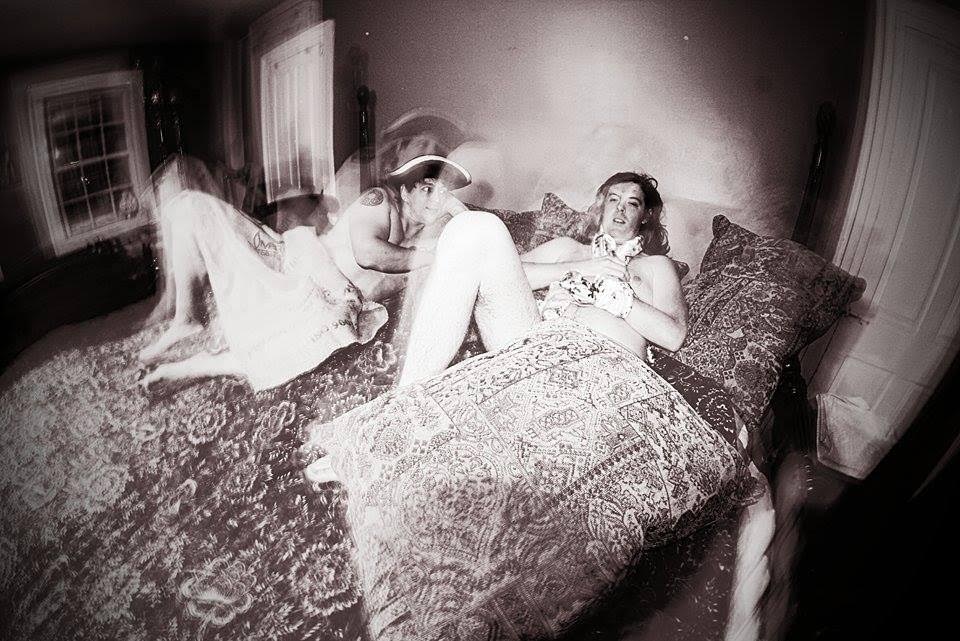
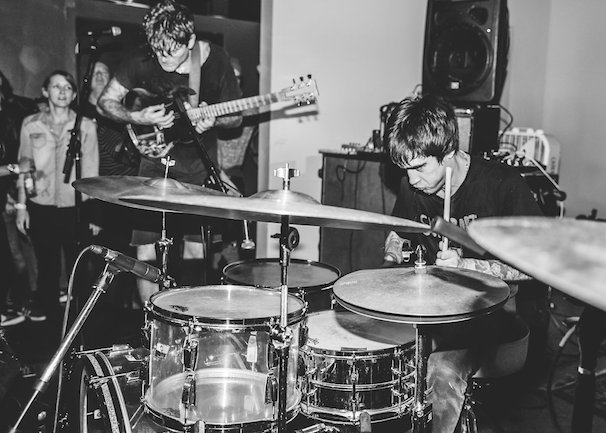
Band photo by Sophie Greenspan; Stoppiello on the left, Rosati on the right.
When I walk up to the Jamaica Plain house in which Jacob Rosati resides, I call him to double check that it’s the yellow one. He answers, confused, claiming it’s white. When he comes to the front door he stops and exclaims incredulously, “It is yellow!” Upstairs, most of his possessions are suitcased and strewn about the hallway he has been living in for two months.
We take the interview into one of his friend’s rooms. Before we can get to any interview, he has given me a huge hug, has brewed us some ginger-mint tea, and is talking garrulously about pulling the last crop from his beloved garden, Murakami books, and his soon-to-be move to Mexico City.
It would be hard to expect for such a soft-spoken person—and as someone who didn’t know the color of the house he was living in—that he’s the mind behind one of the most brazen and scrupulously detailed albums to be released this year.
Ponta Delgada, the latest record from his band Skinny Bones, pushes against almost everything familiar about the project’s previous work; almost completely gone are the resigned lyrical musings, the soft wobbling guitar. Instead comes a violent exploration of one’s identity in relation to another’s.
Most strikingly, the album draws heavily on techno as its foundation. “It’s all I’ve been listening to for the past two years now,” Rosati confesses in a separate interview, along with Chris Stoppiello, the other half of Skinny Bones. “And I tend to emulate what I’m listening to.”
Calling techno the “listening man’s dance music,” Rosati, who does all the recording and is the principle songwriter for the duo, has been interested in the expression that style of electronic music allows for.
If you knew Jacob personally, this change in direction would come as no surprise. The young musician has been organizing techno shows under the Cake Factory name for almost one year now.
But the two are interested in more than just traditional techno music; Ponta Delgada is an exercise in bridging the mechanical four-to-the-floor aspect of dance music with the organic feel of a human band. The record was recorded almost entirely sans metronome, a challenging feat for electronic music.
There are calculated imperfections throughout. In “Dropped Bench Press” each measure’s fourth beat hangs on a little longer than its standard allotment.
Recording without any click track is what Rosati calls a “hallmark of dance music.” The two wanted the record to feel flawed just at the tip.
“There’s a lot of stuttering that happens and you can’t ever quite grab onto it… Because of that I think it feels a little more human in a lot of ways.”
“I really love repetition,” Rosati elaborates, enamored, on his admiration of techno. “Whenever I take field recordings, they can feel like this ametric, beatless entity. But whenever you put a loop on it… all of a sudden you start to hear all these percussive moments. Techno does the same sort of thing.
“But that kind of repetition is sort of like a meditation. In pop music you get to this where you get to the chorus of a song and a thousand things happen at once,” he continues, excited. “But in techno there are very small changes. Not even new parts entering but filters changing.
“Those little changes become so impactful. It’s like lowering your threshold for what’s important. And then all of a sudden everything is much, much more important. I’ve definitely spent a lot of time listening to skipping records over and over and over.”
He caught the bug, then spread it to Stoppiello. Now, the two have slowly been shifting Skinny Bones to be a fully electronic band.
Stoppiello believes “as a group [they’ve] been wanting people to appreciate the electronic element more and more. I think this new record is the one we’ve been wanting to make from the start.”
“We never had the skills to achieve ‘polished,’ ” Stoppiello remarks. Which Rosati adds, “I’ve never been able to pin down why so many… musicians tend to get more polished over time.”
Though polished has never been the goal, perfection certainly has. Rosati has always held an obsessive streak with Skinny Bones.
Even older tracks before the band’s technical savvy faced intense self-scrutiny. To achieve their signature guitar timbre (think “Sleep In”), the instrument’s output was pitch-shifted up, snapped down, then up again back to its original octave. Ultimately, the pitch was the same as it started, but the tone kept the artifacts of change, producing their brand of wobbling sound.
But guitar tones have largely been abandoned now. With their new material requiring little need for the instrument, the band’s live set has now foregone the instrument, going so far as adjusting their older material to fit as well.
Both agree that a band shouldn’t just rehash the same version of their recorded work. To them, presenting reworked material is a matter of acknowledging the audience’s presence.
“The computer is also a third band member, the way we’ve always treated it in a live performance,” Stoppiello explains. Because both musicians worked on different software programs in the early days, they had to recreate the files they were performing for each performance. The two now joke that their live show is a actually a “Skinny Bones cover band.”
With a grain of salt, Rosati admits he “fully anticipate[s] people to not like it.” Stoppiello jokingly assures him “From the start of us playing together we’ve just been trying to… disappoint all our fans who listen to folk music.”
As it turns out, Ponta Delgada is disappointment’s antithesis. The sonic nuances are as numerous as the fat synth hooks. Water sounds are stretched and used as hi-hats, bird calls are subbed in for traditional snare; it sounds as if someone managed to stuff an exotic island into an 808.
Songs like “Stupid Slow,” Miso, Tofu, Kale,” or “Human Body Feel” satisfy both the hypercritical audiophile and the free-spirited dancer in anyone.
While many of the sonic textures are warm and washing, many of the timbres and palettes are camped smack center in the uncanny valley—enough to make anyone squirm their skin off.
Rosati wields his voice in the same way. For Ponta Delgada, he experimented with new means of vocal delivery, going so far as to record his vocals drunk or with local anesthetic applied to his mouth.
Atop his crisp, vampiric delivery he punctuates his plosives and elongates his vowels, accentuating the music as a drum kit would.
His cold anger (and his layer of numbness to it) are a hand’s reach away. One travels with him into the world of Ponta Delgada.
Place has always played a huge role in Rosati’s life. The band’s last album, Noise Floor, focuses much of its material on the relation one holds their self to their environment or home.
Ponta Delgada takes a new approach to the idea of place. What if you could remove someone away from everything they relate themselves to? Would that jolt be enough to solve a personal struggle?
People relate themselves to their environment. Take an individual away from their home, isolate them or surround them with newnesses, and they can change.
The lyrics of “Ask the Atlantic” set the scene: “Logically this decision is simple/ you risked my health and that’s a massive trust issue/… I’m on an island/ I’m on vacation/… asking the atlantic to distract me from you.”
The island aforementioned belongs to the Azores, a collection of islands off of Portugal where two years ago Rosati vacationed with a few friends.
Ponta Delgada relies almost entirely on this experience—the lyrical content was born out of the isolation he felt there, how it worked its way into him and gave him new ground to climb upon and reexamine a relationship that was troubling him.
“I had a whole narrative flow of my life in Boston,” he says. “I was pulled out of it and was able to sit in this more solitary space.”
Nearly all the field recordings on the album were taken there, including the turbid water samples that punctuate many of the songs. Rosati’s goal was “to make the ocean feel like it had music in it, not music on top of it.”
The particularly unnatural sloshing sounds heard throughout are different recordings of irrigation pipes found all over the island.
“I think that sound exemplifies Skinny Bones,” Stoppiello muses. “Sometimes in the record we just present that sound to just appreciate the sound. And sometimes that sound is a hi-hat. And sometimes that sound is a snare drum.”
He adds that “anything is a kickdrum if it has the presence of a kickdrum.”
Continue reading →

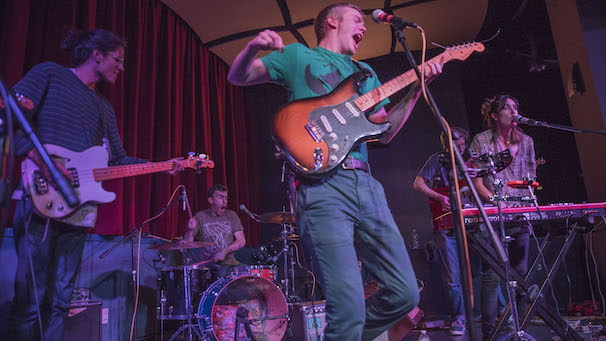




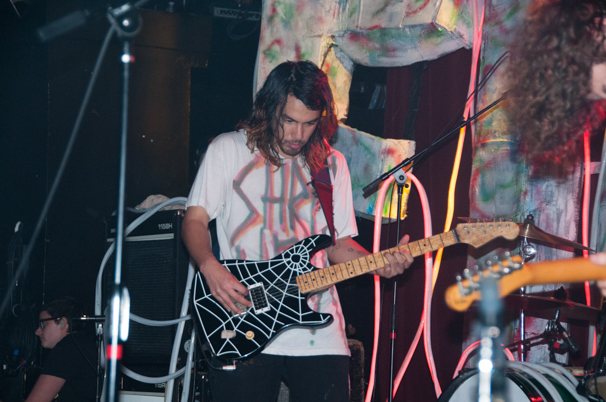








 I reiterate: this is control. It might not be any individual or organized group’s idea of control (although after the last couple weeks in politics, a clear definition of “control” is tenuous at best), but after a decade plus of prolifically churning out psychedelic noise in dangerously small spaces, Thee Oh Sees have managed to zero in on how to grip the reins of their demolition derby.
 ght Arrows had even fully left the stage, trails of sage began wafting around the room. Without anyone recognizing it was Dwyer passing through the crowd, he was already piling up his mountain of speakers and amps, the sage burning amongst his stacks as brightly as the illegal cigarette dangling from his mouth. Sure, Thee Oh Sees would go on minutes later and lead off a riff-heavy set with “I Come From The Mountain”, but the therapeutic entrance was indicative of Thee Oh Sees’ hold on the chaos. The dual drummers’ militant shadowing of one another on newer cuts like “Gelatinous Cube” and “Dead Man’s Gun” was more a hypnotic sight to behold rather than hear (although yeah, they were fuckin’ good and loud).


