Though she might’ve built her career hundreds of miles away from Hopkinton, Massachusetts, Charlotte Sands offered no ambiguity as to where she calls home. Returning to the Boston area for a show at the Middle East Downstairs in Cambridge, back where she first discovered the kind of rooms she herself wanted to fill–made for quite a night. This show wasn’t simply a homecoming: it was a victory lap.
Sands explained from the stage that “being in Massachusetts makes me directly emotional about every experience” that led to her songs and the people they were about. Though she has become firmly embedded in the emo and alternative world, —collaborating with The Maine’s John O’Callaghan and Taking Back Sunday’s Adam Lazzara on “Loved You A Little,” and appearing at both the Vans Warped Tour and the Emo’s Not Dead Cruise —Sands didn’t grow up dreaming of joining the scene. In fact her earliest influences were singer-songwriters like Sheryl Crow and Michelle Branch. It wasn’t until she saw The Maine and We The Kings as a teenager that she discovered the electricity of a pop-punk crowd and realized just how much she wanted to “be in rooms that feel like this.”
The first opener on the Satellite Tour was Cleveland, Ohio’s Hooked Like Helen. Fronted by vocalist and keyboardist Nikki Stipp alongside her husband Jon on bass, the band opened the show with haunting, almost ethereally confessional songs carrying an unmistakable sense of nostalgia and a pop wink. Nikki climbed on anything within reach, threw her body around the stage, and gripped the microphone as though the physicality of her performance were an extension of the vulnerability in her lyrics. She told the crowd that many of the band’s songs deal with mental health, addiction, recovery, and trauma, while adding that she was 14 years sober. Stipp introduced the final song, “Promise Me You’ll Run,” as one she had written for the inner child she now wants to protect in the way no one had before.
Out In Front took the stage after Hooked Like Helen, with singer and guitarist Madie Renner eagerly exclaiming, “We got some punk rock kids in the crowd tonight!” The Los Angeles band played with infectious energy, looking completely at home onstage and, more importantly, like they were having the time of their lives. That exuberance stood in contrast to some realities Renner acknowledged before “Medicine,” the band’s newest single, which she explained was inspired by the sacrifices that come with pursuing music as a career. We’re talking missed birthdays, weddings, and other moments that happen while you’re on the road. Their hook-heavy pop-punk was practically built for a room to sing along to, something that became especially apparent when they launched into Fall Out Boy’s “Sugar, We’re Goin Down” and the crowd enthusiastically joined in.
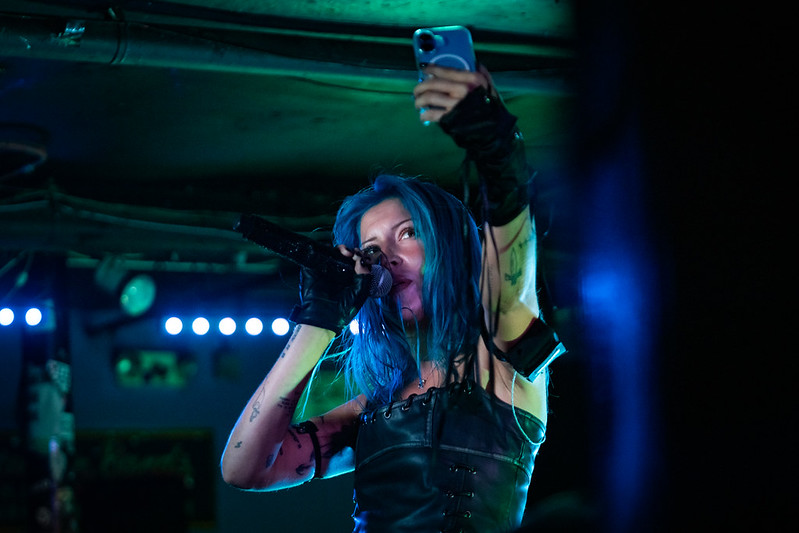
Both openers were well matched to the night, each building the energy before Charlotte Sands took the stage. But once Sands appeared, the relationship between artist and audience immediately felt different. The crowd—overwhelmingly female and mostly in their twenties—pressed toward the stage to get even closer to her. Sands seemed to recognize people throughout the room, greeting fans by name, reaching for their hands and handing out guitar picks throughout the set. When a cheer of “Go Char!” filled the room, the blue-haired singer teasingly asked if her mother had Venmoed the crowd to do it. Cheers followed for both of her bandmates and then her parents. “Let’s make it about me again,” she joked, clearly aware that she had the room in the palm of her hand.
Sands stopped during the show to acknowledge how unusual it was for everyone there to have ended up together in one place, asking the crowd to “recognize how beautiful that is.” It’s the kind of sentiment that could easily register as standard show banter about gratitude, but Sands spent the night putting it into practice. She sang directly to fans and repeatedly found ways to make them feel part of the performance. She even brought out a binder containing songs that hadn’t made the setlist. “I’m a people pleaser, as my therapist, Monica, likes to tell me,” she admitted before letting the audience choose two songs for an acoustic portion of the set.
The voices in the crowd were loud enough to overwhelm her monitors. “I can’t hear anything other than your voices,” she told them, admitting that it came in handy when she forgot some lyrics and the audience helped her through. Her energy onstage was just as infectious as her personality. Sands danced around the stage, blue hair flying everywhere, dropping to the ground and spinning around with an almost reckless abandon that made the physicality of her performance feel as important as the songs themselves. Joined by guitarist Dylan and drummer Nick, Sands played off both of her bandmates as she moved between performing untethered to an instrument and picking up both electric and acoustic guitars.
Much of the set drew from her newest album, Satellite, but even those songs weren’t necessarily performed as fans had heard them before. Sands introduced a version of “Afterlife” that she said not even her mother had heard, incorporating the outro of Owl City’s “Fireflies” and pivoting it into another singalong. Between the two acoustic songs selected by the audience, an alternate arrangement and, toward the end of the night, an entirely unreleased song, Sands seemed less interested in simply reproducing Satellite than in giving the audience something particular to that night. She was equally uninhibited between songs, scanning the crowd and asking, “Are any of my exes here? Come on, be brave. Come to the front.”
The hometown show also meant that some of the people Sands was singing to had known her long before she was commanding stages of her own. Her high school librarian was among the familiar faces in the crowd, along with her parents, brother, and sister-in-law. Sands dedicated “Sunday” to her brother and sister-in-law, calling them her best friends and describing their relationship as the model for what she believes love should look like. After her last song, Sands ran offstage to embrace her parents.
That sense of family extended to the small team responsible for getting Sands onto the stage. She acknowledged that a crew of just five people had built everything around her, making a production of this scale possible while she continues to operate as an independent artist. Sands was equally clear that the audience was part of that equation. “Because of you all in this room, I’m allowed to continue to be an independent artist,” she told them. “It takes a village.” Her words gave the community she had spent the night celebrating a tangible role in the career it was there to support.
Sands has come a long way from the kid growing up in Hopkinton who first discovered the electricity of the alternative scene from inside its crowds. “I’m a Masshole through and through,” she declared to loud cheers. If the hometown audience seemed determined to make the night special for Sands, the feeling appeared mutual. As the show wound down, she admitted, “This might be one of my favorite shows I’ve ever played ever.”
Years after deciding that she wanted to “be in rooms that feel like this,” Sands returned to Massachusetts at the center of one she had built herself—surrounded by the family who knew her before the blue hair, the team helping her build an independent career and a crowd loud enough to sing the words back when she forgot them.
“If there’s one place I’ll always come back to,” Sands said, “it’s this place.”
Check out the rest of Greg’s photos below.
