
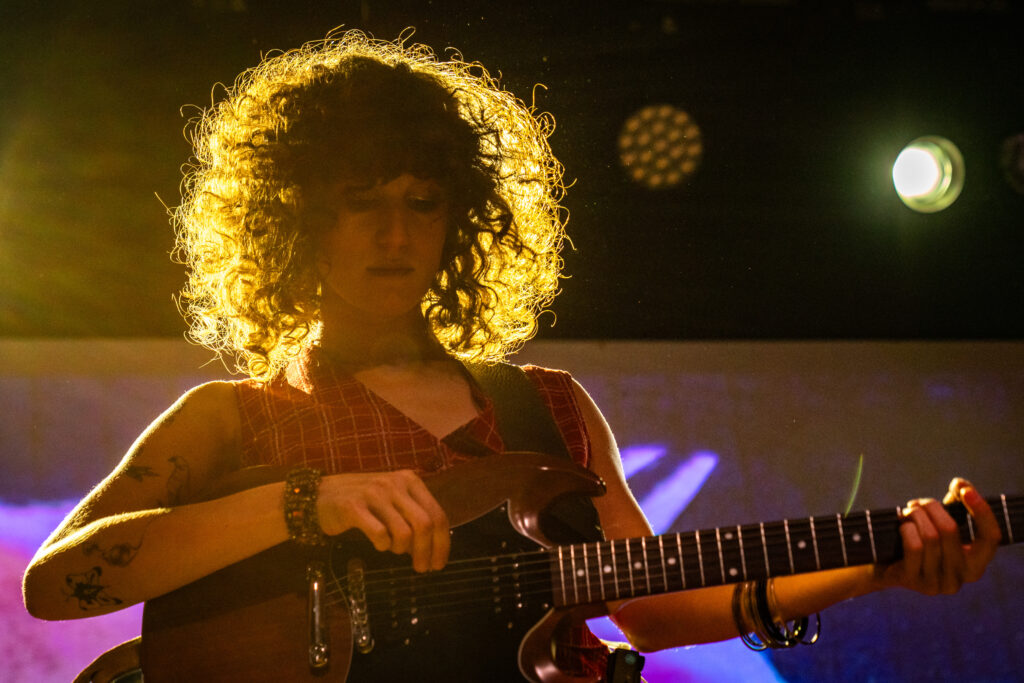
Squirrel Flower, the musical moniker of Ella O’Connor Williams, blends poetic lyricism and indie folk sensibilities with a grunge edge on her latest record Say a Prayer to the Gods of Getting Going, released in late August. Williams, who grew up in greater Boston and came of age in the city’s DIY music scene, played a hometown show of sorts at Somerville’s Crystal Ballroom on the 26th. Williams and her band, with support from NYC indie rock group Youbet, performed their fourth show of the North American tour smack in the middle of a Nor’Easter.
But the show was anything but gloomy: the ballroom hosted folks of all ages, taking solace in the raw vulnerability of Williams’ lyrics and the rousing live performance of the band. By the end of the evening, a sense of kinship, camaraderie, and intimacy was palpable in the venue, summarized by Williams’ cheerful reflection on her return to Boston: “I haven’t lived here in 12 years now, and it’s changed a lot… but this is still my home.”
On this rainy Saturday night in Somerville, the full ensemble –– which featured Chet Zenor, Sean Hallock, Gus Martini, and, later, Williams’ own father and siblings –– brought the music to another level. While the album features a range of stylistic influences, ballads, and more experimental sonic motifs, the group’s performance thrived the most during moments when it leaned into the full-bodied rock sound, reminiscent of Wednesday’s buzzy guitars and Snail Mail’s catchy chorus hooks. Williams herself refers to the band’s sound as “witch rock,” an apt descriptor for an artist as rooted in the longing and loneliness of ‘60s and ‘70s folk as she is in the passion and power of Americana rock and modern indie.
Opening with the title track, which sets Williams’ ethereal vocals against layers of fuzzy guitars, Squirrel Flower captivated the audience from the start of the set. Alongside older tracks like “Red Shoulder” and “Not Your Prey,” the band played the new album in full, showcasing not only Williams’ growth as a songwriter, but also Say a Prayer’s arc, as, among other things, a road trip album. Drifting from “canyons of New Mexico” to “bunkers of California” and the Great Lakes, the album’s speaker traverses literal highways and emotional valleys in equal measure. Squirrel Flower pays homage to the liminal spaces of the American Midwest on the power-pop anthem “Cleveland” and the twangy, wistful “Surfing USA.” A different song, “Fought a Hornet,” cut back on instrumentation and highlighted the soft clarity of Williams’ voice alongside acoustic guitar, almost eerie in its entrancing quality of stillness, in contrast to some of the more upbeat songs’ momentum.
On the melancholic, stripped-back track “Highway Woman,” Squirrel Flower emulates folk greats like Joni Mitchell and Lucinda Williams, while illustrating the duality of a life on the road: mundanity and mystique alike. Despite arriving at the midpoint of the album, the song’s outro feels like a thesis statement from Williams on the nature of being a working artist and finding pieces of home all across the country –– “you can change it as you go / you do not plan on dying.” Throughout the show, the setlist touched on these themes of growth and sacrifice, listlessness and devotion, and everything in between, emotions that, for Williams, seemingly mark those long periods of self-reflection on the road, as well as seep into the creative ethos of Squirrel Flower.
To close out the show’s four-song encore, Squirrel Flower brought local musician friends, opening band Youbet, and Williams’ two siblings on percussion and vocals back to the stage for a “family band” finale. With egg shakers and tambourines, extended lead guitar jams, and, as Williams joked earlier in the set, “[her] whole extended family” cheering in the audience, the show’s conclusion left me joyful and slightly emotional. Williams strikes a perfect balance between the specificity of her lived experiences and a sense of universality in her writing, resulting in a catalog, and a live stage presence, that is both moving and electrifying. Even for those of us who have not grown familiar with the years of routines of touring, travel, and festival performances, there is something relatable and poignant in Williams’ musings on losing and being lost, finding and being found, and navigating the wide-open highways of young adult life with gratitude and wonder.