Cover art by Jillian Dominique provided by Joe Froeber
Allston Pudding is delighted that Dolata are premiering their first release, “Friday Girl,” with us today. Dolata were formed by North Shore native Joe Froeber (vocals, guitar) and Boston-based artist Madi Donlan (vocals, synth). They enlisted drummer Reilly Somach and bassist Amelia Allison (who swooped in when the first bass player ghosted them) for live performances and their upcoming debut record.
Having notched their first ever gig earlier this year at the Lizard Lounge, Dolata are now releasing their new single, “Friday Girl.” The song is about singer Donlan’s late friend Jillian Dominique who’s art appears as the cover of the track. “Friday Girl” is an introspective dream pop tune that builds up from an understated two string guitar riff, accompanied by sparse ride cymbals and floor tom flourishes. What immediately stands out is the atypical connection between the lower female vocalist Madi Donlan and higher male vocalist Joe Froeber. The roomy and reverb soaked mix holds an ethereal space that the four piece inhabit, conjuring memory of the deceased.
“My best friends all moved away/ you still live right down the street/ but we can’t even speak” is incanted right before the beat drops. The wordless choruses contain solely an “ooooooh” before breaking into an extended instrumental synth jam that dissipates back into the oblivion from which it began.
Listen to the Allston Pudding premiere of “Friday Girl” below. We look forward to hearing the rest of the EP.
If you’re a fan of Greater Boston’s incredible food scene like myself, then you too have probably heard that a certain giant marshmallow-esque figure might be making its way to our bustling Beantown. Yes, the always controversial Michelin Guide will be debuting its long-awaited Massachusetts edition after many years of uncertainty and flat-out rejection.
Why exactly did it take so long? Polarizing opinions regarding the Guide’s pay-to-play model – where tourism boards must fork over hundreds-of-thousands, if not millions of dollars, to bring the Guide to their cities – have kept it from breaching state lines. On top of that, those who find themselves outside of the culinary community remain flummoxed as to why a tire manufacturer is regarded as the most respected opinion in global hospitality.
In short, many years ago, a very smart decision was made by Michelin to encourage tourism – in favor of tire sales, by debuting a restaurant/hotel guide to incense travelers to head out on the open road. To try new places, stay at new hotels, all the while slowly wearing down their tires. So the annual Michelin Guide steadily rose to prominence by hiring professional food critics and awarding stars and special commendations to restaurants and hotels around the globe.
Honorees at the 2024 Michelin Guide Ceremony in Florida. Photo by Zach Hilty/BFA.com
Now, destinations like Atlanta, Austin, Chicago, D.C., Los Angeles, Miami and New York all have guides – which has only led to more speculation as to why the Boston area remains unrecognized. That is, until now. The local tourism board Meet Boston and the Michelin Guide struck a three-year deal announced back in May for an undisclosed amount, to bring their secret food critics to our city.
So, what happens now? The Michelin Guide Northeast Cities Edition Ceremony is set for November 18th in Philadelphia. Restaurant owners typically learn day-of if they’re due to receive an award, followed by a celebration the following evening where all of the honorees will be announced. The exact location of the Michelin event is TBD.
So, which restaurants will be recognized? No one outside of Michelin and maybe some industry insiders knows at this time. But, as hungry journalists missing crucial information, we can speculate! There are many establishments that warrant inclusion in such a guide, so here are a select few (er… 50) broken down by neighborhood, for your epicurean and viewing desires. Some of these picks have higher chances than others at being selected, but all are deserving of our attention.
Back Bay
Insalata Verde and Meatballs Aldo at Contessa.
As one of Boston’s most exclusive neighborhoods, it makes sense that it would house many of the city’s most exclusive places to dine. Seafood definitely takes the spotlight here with standouts like Amar, Mooncusser, Ostra, Saltie Girl, and Wa Shin with the latter gaining an edge as one of Boston’s top omakase/sushi outings. However, Italian spots Faccia A Faccia and Contessa present worthy competition alongside French bistro Mistral, Greek wine bar Krasi and the New-American Asta.
Brookline Village
Just down the street from Brookline’s more-popular Coolidge Corner, the quaint Brookline Village keeps up with the culinary diversity of its neighbor, including a local-favorite Thai place Mahaniyom & the innovative Szechuan spot Noah’s Kitchen.
Central Sq. (Cambridge)
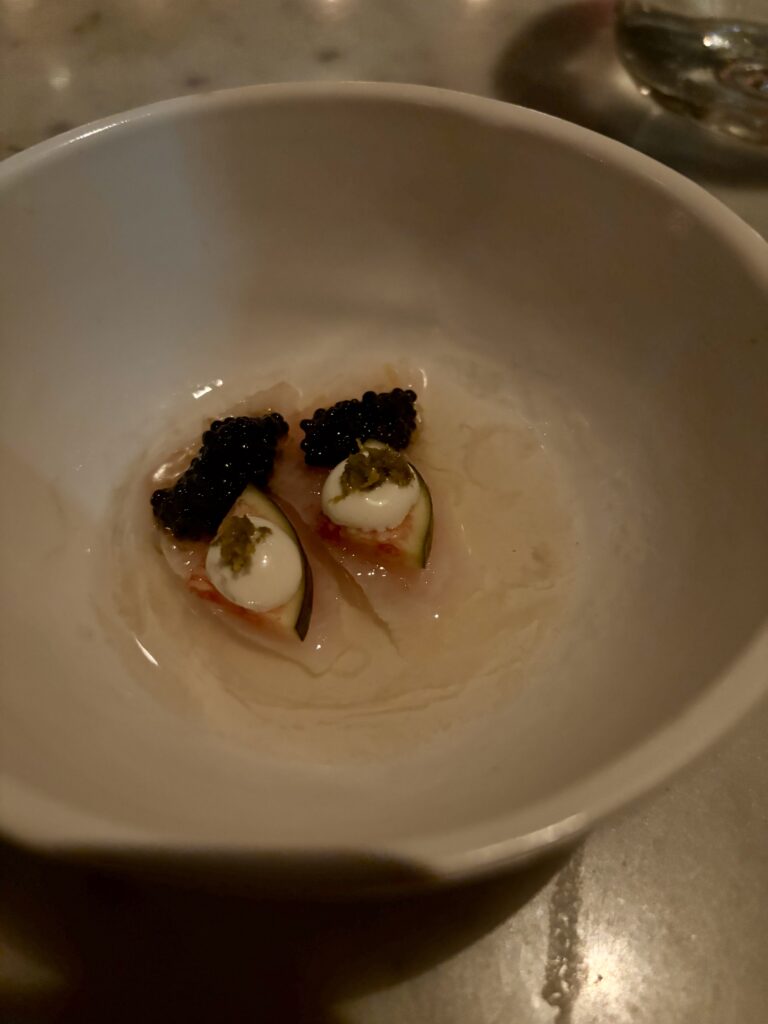
Crudo with caviar and watermelon radish at Pammy’s.
Nestled in the heart of Cambridge amidst plenty of stores and coffee shops, Central Square remains one of the city’s most popular spots. With plenty of places to take a load off after you’re done exploring, you may find yourself drawn to Japanese/Spanish tapas bar Pagu, the trendy (and Maggie Rogers’ approved) Pammy’s or rooftop Vietnamese space Saigon Babylon.
Chinatown
If not for the North End, this may be Boston’s most iconic culinary neighborhood, boasting streets packed with eateries, markets and shops. The options may be overwhelming but you can always make a safe bet on industry favorite Peach Farm or Asian fusion spot Shojo, which is right up the street.
Davis Sq. (Somerville)
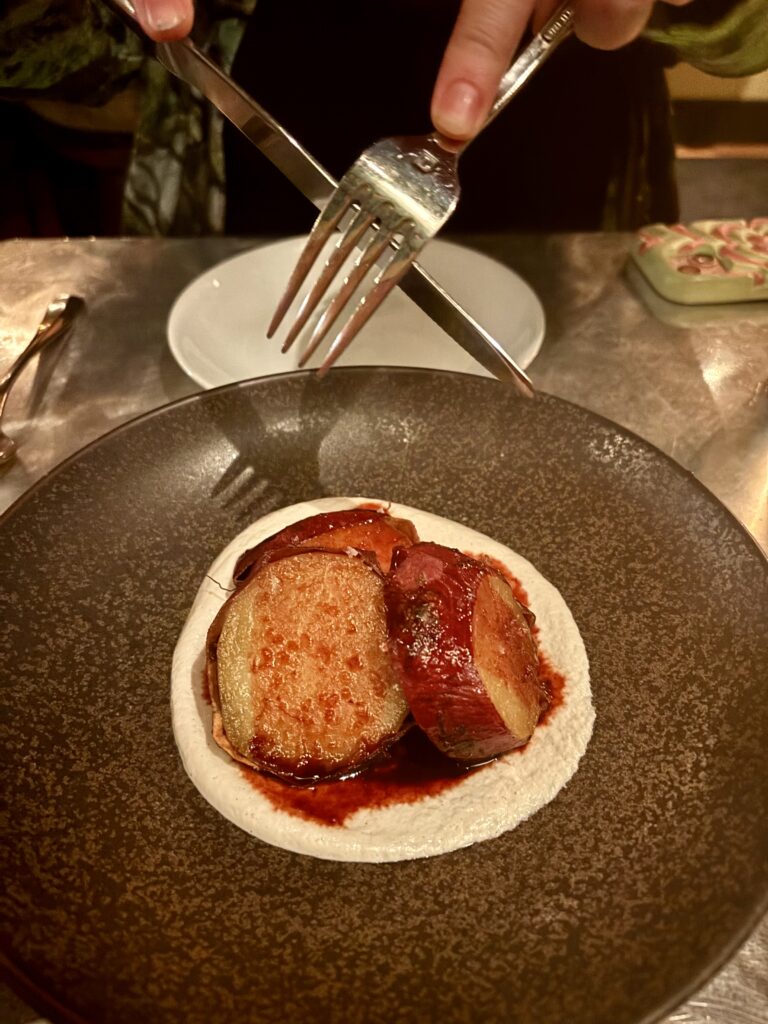
Sweet potatoes with labne at Spoke Wine Bar.
A quaint yet frenetic neighborhood, Davis is home to many iconic Greater Boston destinations including The Burren, Somerville Theatre, Red Bones, Dragon Pizza and the Rockwell. However, when it comes to dining, you can’t beat Spoke Wine Bar just up the street with their inventive and modern take on farm-to-table cuisine.
Downtown
While it may seem like a no-brainer for the main part of Boston to be full of worthy offerings, the area has fallen into a mixture of tourist traps and fast casual selections. However, you can still find a haunt or two worth visiting including the very well-known speakeasy Yvonne’s and tinned-seafood fan favorite Haley.Henry Wine Bar.
Harvard Sq. (Cambridge)
Come for the education or live music and stay for the elaborately decorated tiki bar full of intoxicating libations at Wusong Road or show Mother Nature some love with the farm-to-table/zero-waste spot Forage.
Inman Sq. (Cambridge)
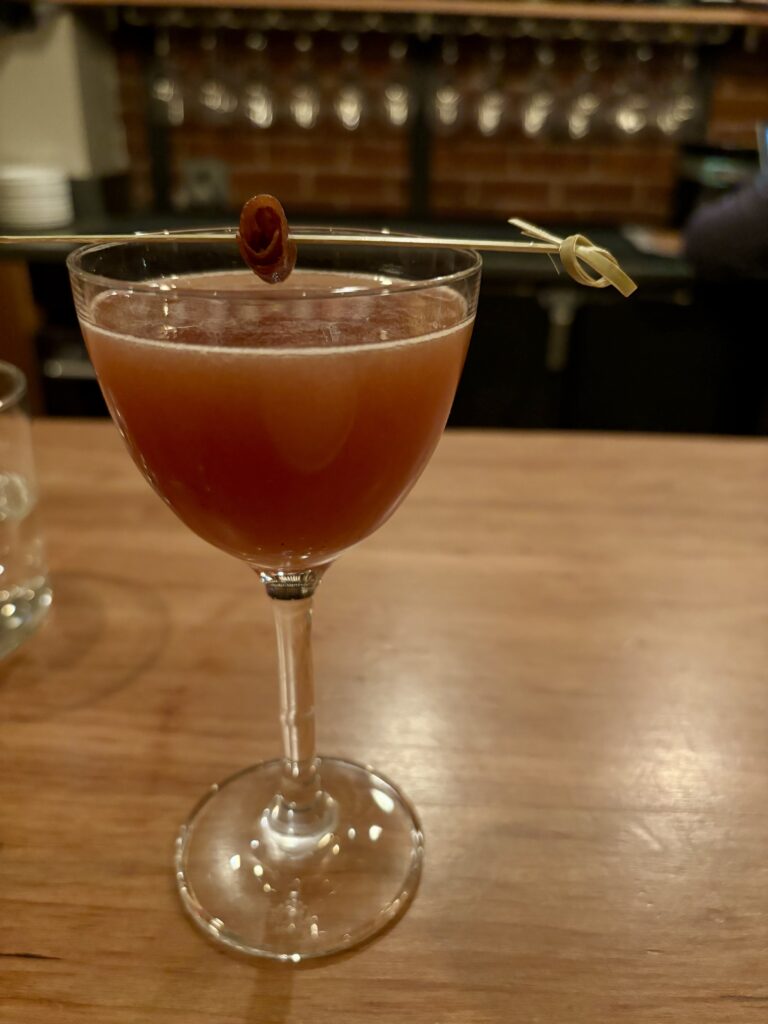
Seasonal Sharbat at Oleana.
A cozy neighborhood in Cambridge that doesn’t mess around, boasting two widely respected offerings on its roster. Be sure to check out local favorites Puritan & Co. and Oleana, with the latter sitting comfortably atop many lists for a possible star.
Jamaica Plain
Pick a day with nice weather, take a lovely stroll down the Jamaicaway and find yourself within steps of top Italian eatery Tonino or Brassica Kitchen + Cafe, a French cafe by day & modern tasting menu spot by night.
Leather District
Perhaps the first place on peoples’ minds when it comes to possible Michelin stars in the Boston area is the cozy omakase-based o ya, whichremains one of the city’s most sought after reservations.
Neighborhood Nine/Porter Sq. (Cambridge)
Known for bagels, ice cream and ramen, this area regularly offers the industry-favorite Italian staple Giulia, fan-favorite outing Gustazo Cuban Kitchen & Bar and New American fare with the cozy Talulla or the rustic Urban Hearth.
North End
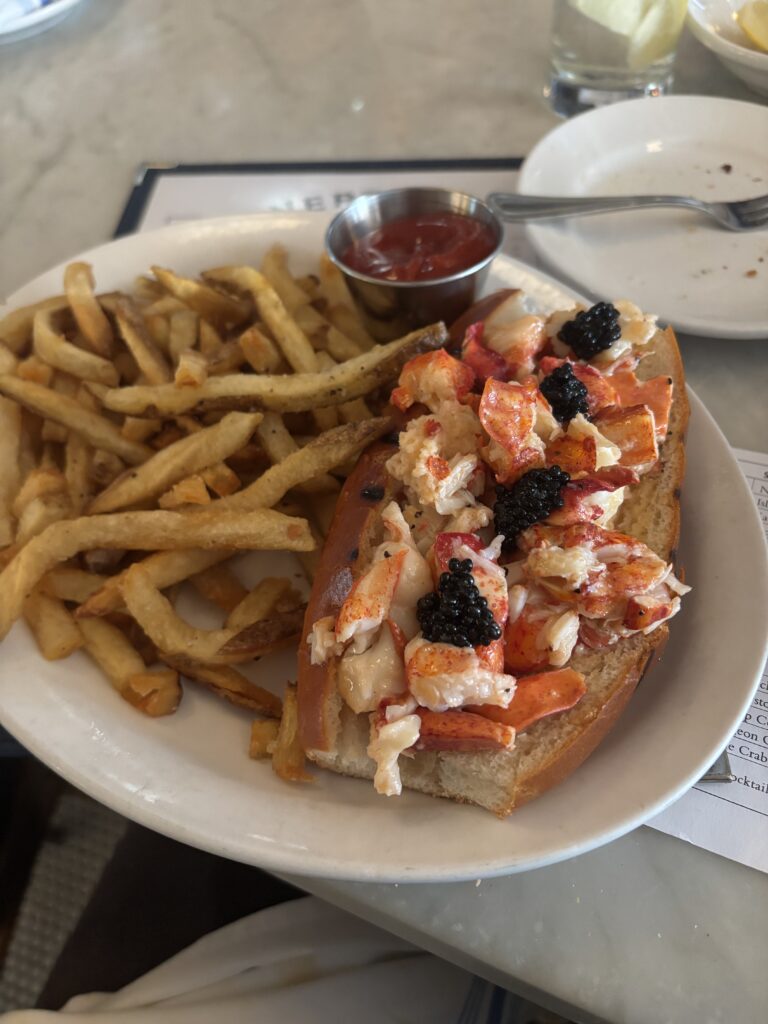
Warm lobster roll with caviar at Neptune Oyster.
Arguably the most iconic and beloved neighborhood in Boston, the North End is known around the world for its bountiful supply of cafes, bakeries, restaurants and sandwich shops. Picking a favorite is difficult, but not impossible as folks keep coming back to Mamma Maria, Neptune Oyster or The Red Fox for their offerings. If you don’t trust us, just ask Dua Lipa.
North Quincy(Quincy)
Brave the afternoon traffic down 93-south, or hop on the red line and venture south to North Quincy to experience some of the area’s most popular Chinese cuisine at a Hong Kong-style daytime cafe, Rubato. Keep an eye out for special nighttime tasting menu events hosted by their executive chef.
Nubian Sq.
What better way to relax after a long day of perusing the shops in Nubian Square than to take a load off and fill up on comforting West-African cuisine at neighborhood favorite Suya Joint.
Seaport
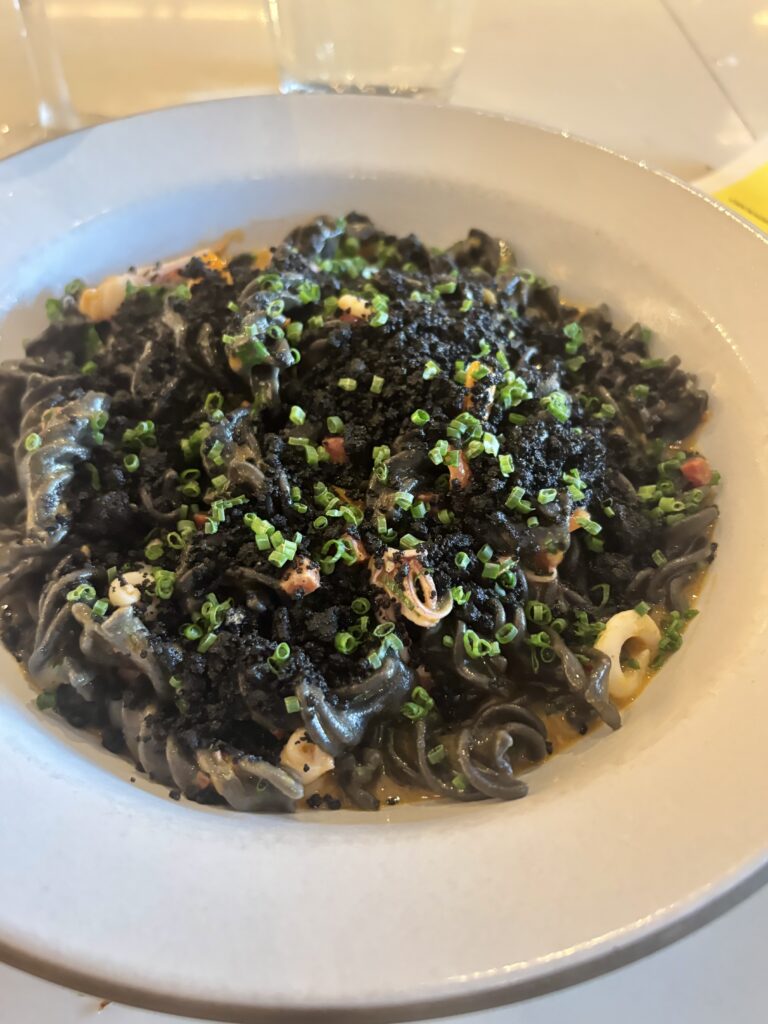
Squid ink fusilli at Chickadee
Boston’s newest neighborhood, it quickly became a hotbed for upscale shopping, trendy TikTok popups and tech bros. Eliciting eyerolls from longtime residents, the area does boast a few fantastic places to grab a bite including the chic Chickadee for Mediterranean fare & high-end New American stop Woods Hole Pier 4.
South Boston
Just over the tracks from the South End rests Fox & the Knife, a rustic Italian-inspired New American offering from chef Karen Akunowicz, who used to work at another Boston favorite, Myers + Cheng.
South End
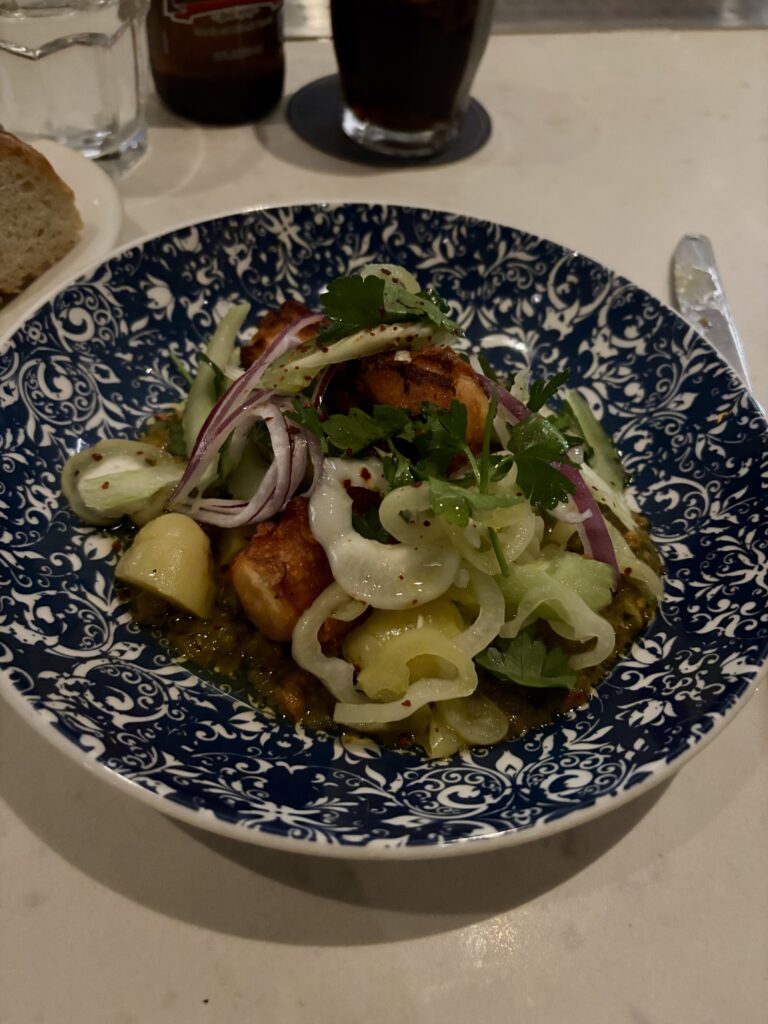
Grilled octopus at Bar Mezzana.
One of Boston proper’s trendiest neighborhoods, thanks to its adjacency to local artists/theatre, eclectic bars & funky shops, the area also boasts a laundry list of amazing restaurants. Italian fans can rejoice with the tantalizing Bar Mezzana, viral date-nite spot Capri and porcine-minded The Salty Pig. Complete the tour of Southern Europe with Portuguese staple Baleia, the celebrated Grecian standout Kaia or the beloved Toro, for some of Boston’s favorite tapas from Chef Ken Oringer.
Union Sq. (Somerville)
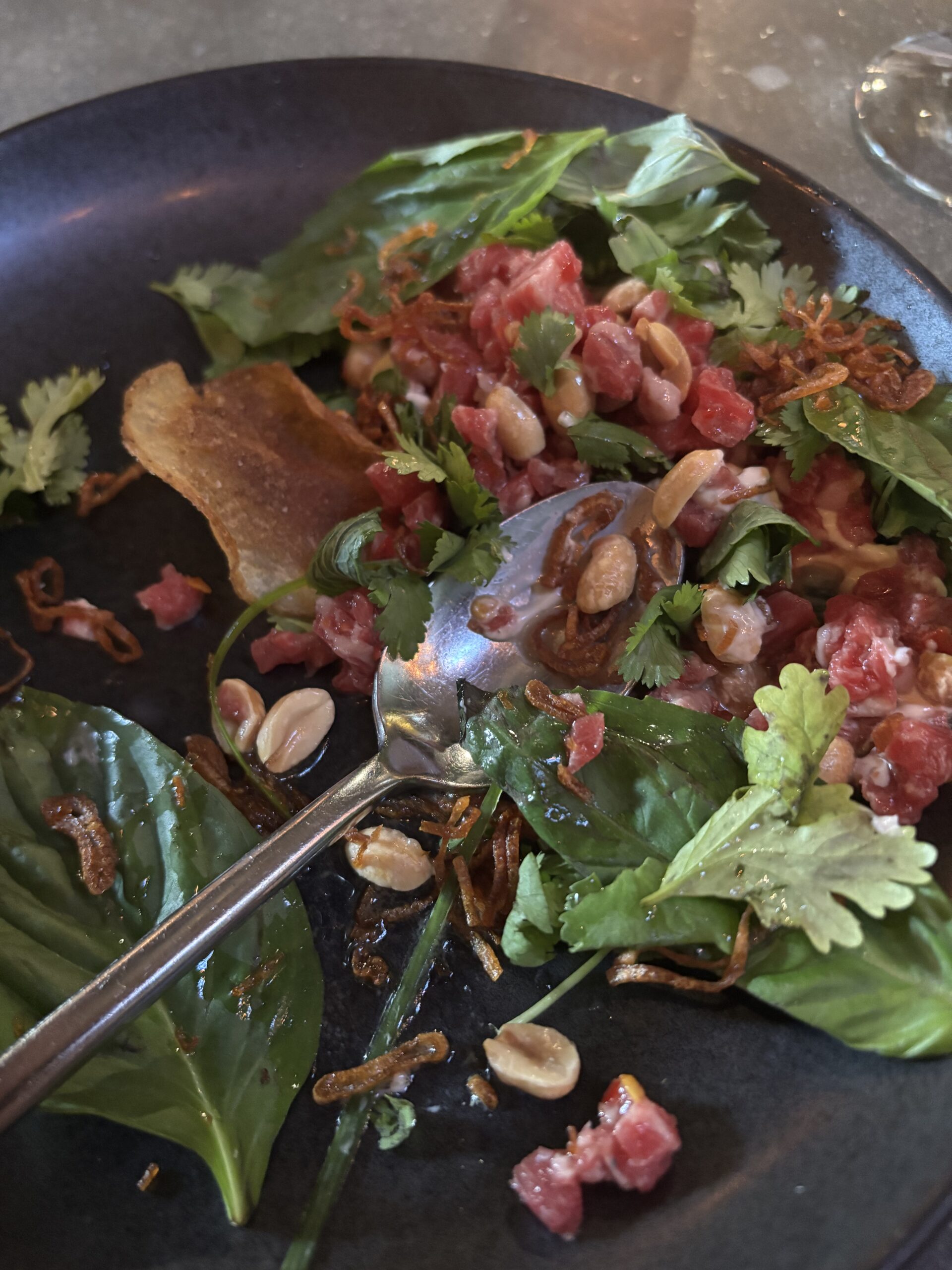
Beef tartare with nuoc cham aioli, fried shallots, peanuts, herbs and house chips at Field & Vine.
Dotted with fantastic places to grab coffee, donuts, Peruvian food, pizza, sushi, records and more, it can be hard to decide where to go first in Union Square. Fortunately, the farm-to-table fare at Field & Vine and the unique libations at Backbar are pretty good at making your mind up for you. It doesn’t hurt that they’re literally next door to each other either.
Upham’s Corner
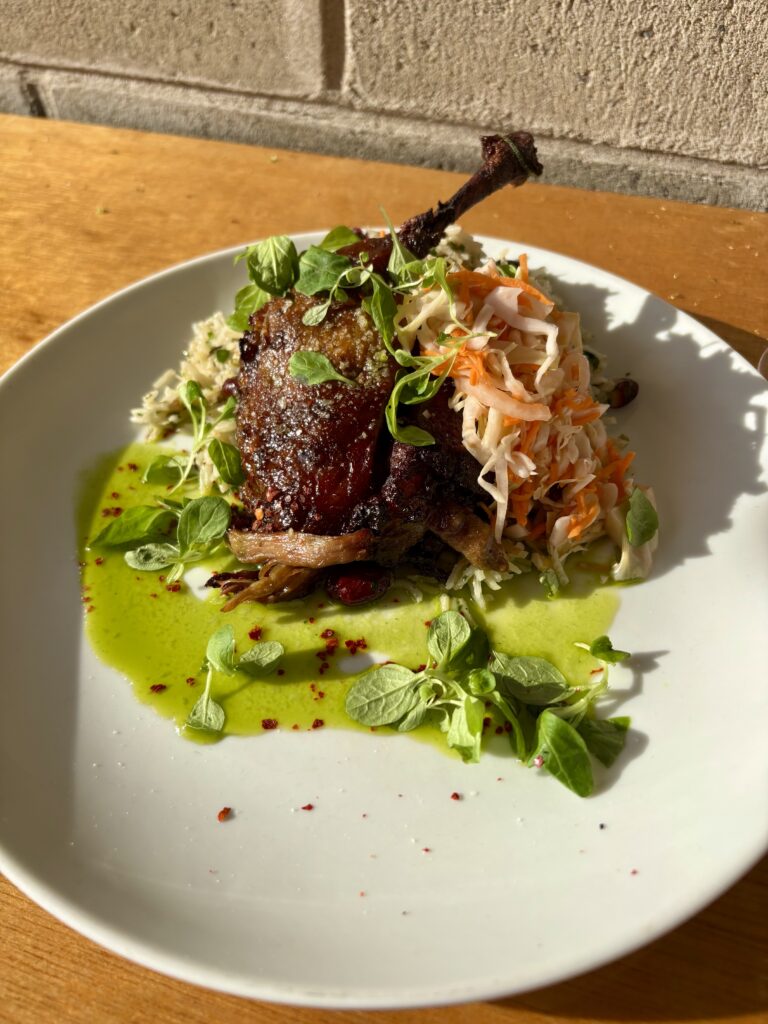
Jerk duck leg at Comfort Kitchen.
Housed within a reclaimed street car station from 1912, the space was renovated and eventually given new life as Comfort Kitchen, a James Beard-nominated spot which celebrates food of the African diaspora.
Washington Sq. (Lynn)
Lynn may not be the first city on everyone’s minds when it comes to upscale dining, but one restaurant is putting in the work to change that. Featuring an unconventional “blind” tasting menu, which is tailored to each table and curated by chef-owner Rachel Miller, Nightshade Noodle Bar is putting Lynn on the culinary map.
Winter Hill (Somerville)
Lamb loin chops with black garlic butter, sweet potato, gremolata and lime at Sarma.
Last, but certainly not least, the bustling and tastebud-tickling Sarma from chef-owner Cassie Piuma has been pleasing Somervillians & beyond since it opened in 2013, with its fresh take on Middle Eastern meze – but only for those who manage to snag a table.
Keep an eye out for official news/announcements from the Michelin Guide! Until then, happy eating & best of luck to everyone shooting for the stars!
It’s been a big year for Boston indie rockers Tiberius. A couple cross-country tours have taken them as far as Texas while they’ve also found the time to play on what feels like every great band in town’s record release party all while readying their own fifth LP (and very first on hotly-tipped label Audio Antihero) entitled Troubadour. A massive leap for an already well-established group, the record finds fronter Brendan Wright writing vividly about their travels across this big nation, the allure of music scenes beyond our fine city, and the backbreaking work that is schlepping heavy ass gear from basement to basement among other topics. Moving from blistering college rock guitar manglers to pretty, steel-accented Americana (sometimes within the same song), Tiberius have truly made one of the year’s greatest sounding rock records coming outta anywhere.
Astute readers will recall that this album cycle started on this very website with a premiere of initial single “Sag”, so it feels fitting that we got the chance to sit down with the now-five-piece Tiberius ahead of Troubadour’s release, which is today. Hit play on the stream below and read through our musings.
AP: So when are you moving to New York?
Brendan: Cat’s outta the bag, huh? You know, there’s nothing in the works right now, but I’ll definitely ask everybody their plans for next year, starting September 1st, the cycle. As of right now, I’m going on the record as saying I don’t have plans to go anywhere., but ask me again in like six months.
AP: This record has a lot of characters. How much of yourself do you place within them?
Brendan: I think that they all sort of stem from personal places or personal experiences, though I feel like as the songs become what they are, they become more abstracted over time. It’s really interesting where I think some of these songs, to some degree, start out as like comfort songs or little odes of just trying to find solace in a crazy time in your life. But then as I show them to these guys and we work on them and we record them and we play them they become completely different. Like the feelings of those songs become completely new so I forget a lot of the time what they’re actually about. When we’re playing them on stage I’m thinking more about other times that we’ve played them together or trying to make one of the fellas laugh on stage when we play, as opposed to being right there in the songs.
AP: Another theme of the record feels like driving, or traveling in general. How much does the road influence this band?
Brendan: I think this record is certainly influenced a lot by the road or by traveling, but I think that a lot of it is about understanding yourself in different spaces and in relation to different people and places and objects. I think from the time that this was written and now even I think a lot about myself in relation to the kind of structures around me in my life and how those can change over time.
AP: It seems like there’s a sort of fixation on the West, too: Moab, Albuquerque, South Dakota. Is there anything about that area of the country that is especially inspiring to you, or is it just a function of how the songs, or where the songs were written?
Brendan: I feel like a lot of the songs were inspired by this really big trip I took out west, which was kind of an opportunity to get myself away from Boston. I mean I love Boston, but also I hate it sometimes. I think that when a lot of the songs were written it was my first time experiencing really anywhere outside of the Northeast. So I think there was a lot to talk about, a lot to feel.
I feel like the West is so vast and I was thinking a lot about how the places that really stood out to me in the West were ones that were just kind of like random, like a gas station in the middle of South Dakota somewhere that was just in the middle of nowhere. There wasn’t anything necessarily significant or special about that, but it was just like, ‘Oh, I’m gonna remember this spot for the rest of my life because I’m never gonna come back here’ you know? Maybe not, maybe one more time we’ll see. I was just thinking about how there are certain landmarks that you think are gonna be really significant, and it’s always kind of surprising which ones end up being the ones that really make you feel something.
AP: “Sag” is kind of like a song that deals with the minutiae, or the. bullshit things you have to do to make your art. How do all of you sort of avoid getting jaded while still maintaining joy in making music?
KP: I think about this a lot. Just at least in my life, I’m very busy and I’m always doing a million things, but I find that having something else to focus on, whether that is a good thing or a bad thing, makes coming back to music a little sweeter. You know, even with its various…characteristics that make it fun or make it sucky, like everything that makes this experience this way. The moment I’m doing something else, I’m like, ‘Man, I kind of miss the shitty driving everywhere, I miss being stuck in a car with the guys’, so I don’t know. I think lit’s easy to glamorize this lifestyle when I’m at my 9 to 5.
Colin: I’ve now moved cross country twice in pursuit of various musical projects, and that adds a layer of pressure like ‘Oh, you came all this way to do this—don’t fuck it up.’ Why aren’t you doing it all the time right now? But also, the flip side of that is that music becomes such a common experience like ‘Oh, this feels the same here as it does in the West Coast, as it does in New York, as it does anywhere.’
Pat: I just think: what a lucky way to connect with people. I did a lot of music through school, but not really like socially or like not primarily socially. I didn’t really try to get band together with friends or like until like I was probably 20 or 21, but there’s just nothing like it. To really see someone play and really connect with them musically, it’s definitely what keeps me coming back. You can be so down on everything musically or artistically, and then you see one person play one thing, or one song, and it’s just like…magic. Even something small like that can just melt everything else away like the pressures or the time commitments and stuff like that.
At the end of the day we’re all just playing songs, and we all love songs, and we all love music. Playing music, and making music with other bands that we get to meet on the road or at home. On good days it feels like such a treat to go to do this. While it doesn’t always have to feel like that, and it’s not always going to feel like that, but it’s really nice remind myself of those moments, and I always try bring it back to that feeling.
Sam: I came up into playing live music through these guys, so I don’t have the same history that the others have here, but I’ll say that I really just enjoy it thoroughly, especially being on stage and having a really fun time playing with them. I feel like that’s one thing that makes it worth it for me. Ultimately I wouldn’t be putting in as much time or effort if it wasn’t as fun and if the people I was working with weren’t as good as they are. There’s really nothing making me think that I don’t want to be doing this because those things are true. It’s nice. I enjoy every part of it.
Brendan: For a lot of my life music was as an outlet for me, and for things that I was going through personally, I think a lot of the Tiberius songs, they all start from a pretty vulnerable place, but something that’s just been so amazing about being here, especially in the Boston community, is just to be a part of this history. There’s so many artists and peers working together to be a part of this culture. And it’s so fun. And I feel like it makes me feel significant in its own way. It can be so easy at times to get really stuck on my phone and feel like I’m drowning in the abyss of everything going on, so it’s nice to have something that’s very grounded and very communal, almost like a family to keep coming back to.
AP: How do you square ego and ambition with also wanting to be a good member of this community?
Brendan: l feel like i’m constantly thinking about this, like I’m trying to think about the reason why I’m making art to begin with all the time and you know, why being in a community is so important to me while seeing other people in other communities go to places that have more opportunities. While I obviously know Boston’s musical infrastructure can be very limiting at times because there’s a lack of venues specifically serving artists of our size. I’m also aware that people don’t typically move to Boston for the music culture. I think a lot of it is people who are either from here, people who go to school here and are here for a limited time, or people who kind of find themselves in a place where they just like being here. I think that that’s kind of where this band is at, or at least where I’m at.
That said, I think there’s something really special about the community of people that exist here and the people who want to be a part of it kind of just making art for art’s sake. I think it’s really easy to get washed up in the “industry” part of all of this, and I also get that people who want to be professional musicians always have to be looking out for themselves to some degree. But I don’t know, it stinks when people leave a good place sometimes to go in search of something bigger. Maybe if more people stuck around, we’d have something bigger right here. That said, I think everyone’s got to do what makes them happy and what drives them, and if you feel like New York just will afford you more opportunities and that’s your priority then you should do it.
AP: This is a band that’s historically had people moving in and out. Do you find that influences your songwriting in any way or the way that you guys are playing the songs? Do you find it like a challenge or a blessing?
Brendan: It feels like every time we play in a new orientation each song is brand new. Colin is the newest member of the band, and we’re trying to, as this five-piece iteration, work out how these songs kind of exist in this way. A lot of that is cutting parts, rearranging, or trying things with different dynamics and different pedals, or setting up our amps differently in the room. There’s a lot more conversations about what works and what doesn’t work. I think that at times can even be like, ‘I don’t know.’ It’s definitely pushing us into places that are a little further outside our comfort zone, but from my experience it’s been super productive.
KP: That everyone who’s joined the band has been really inspiring. I love working with musicians who are new to me and who have had vastly different experiences than I have because it’s always an ear-opening and eye-opening experience. Where they point something out, and you’re like, ‘Wow, I didn’t even think about that’, which i feel that it always brings new life into the band. I’ve been in Tiberius for five or six years, and I’m a vastly different musician now than I was when I first started. I will say that I’ve had a lot of musical experiences, but I feel like everyone who’s stopped by in this band has really helped be a part of this and help shape the way that I play.
Colin: Having only joined in the past like year and a half or so has been interesting. I’ve definitely always been around indie rock and stuff, but like less emo-leaning, or less kind of harsh-leaning typically and even as an outsider seeing different iterations of this group, from even before I joined I think it’s a cool opportunity in a style that’s traditionally very part-oriented where your part is your part and it all connects to make the song. However, when you’re playing with different arrangements of the group you have to really be on your toes and just play off of each other more which i think is one of my favorite things about playing music in general: being able to just having every performance be a little bit different and its own performance. I think there’s an added kind of external motivation like “well it’s gonna be pretty fucking different now that we have like two more people or like two more instruments than it was originally.” The set is gonna be different every time like when they do a four-piece show on some of the older repertoire that’s a little more rocking. But then the next night we’ll have like a five-piece with like the pedal steel and like everyone kind of has to lock in. It’s a good like mental and musical exercise to know the songs so well that you can stretch the boundaries while still staying in your lane and staying in the box.
AP: What was the impetus of the farm emo thing?
KP: One day Brendan was like, I’ve been listening to a lot of Neil Young. They signed up for that Neil Young streaming service.
Pat: And then I was like, I just got a pedal steel.
KP: Yeah, so I’m not crazy. Those things did overlap. It was Neil Young and then it was Pat and I was like, oh shit.
Brendan: There’s that meme that’s like country music is just farm emo. I Thought that was funny, but I also think that’s accurate for these songs when you strip them back, they’re all kind of just like singer-songwriter ready. You could call them emo tunes folk tunes and it’s always kind of been like that, but I think that the decoration that’s gone around them, and the arrangements typically had that early nineties, big muff on kind of flavor. So whenever I write anything that’s softer-leaning I’m like “wouldn’t it be awesome if at this part we just get really loud and really crazy at the end.”
Which is to say they’re all kind of like folk country songs, just dressed up. When we started working with Jamie from Audio Antihero, I don’t remember if it was something I said in an interview, or if I wrote it down somewhere, but then all of a sudden it got in the press release and then now everybody gets this press release that has farm emo in it. Now people have been putting it out there all over the place. So I don’t know, if it works, it works.
AP: How long have you been at this batch of songs? How much has the live show and this new roster changed these songs from where you began?
Brendan: The songs have been around for two plus years at this point. We were playing kind of a whole different unit, just KP and me and Ben who recorded Troubadour but was kind of already stepping back from Tiberius live shows and putting in more time with Clifford, plus their partner moved to Virginia. So at that point we were playing most of our shows with Sam because Sam was our quote-unquote backup drummer. I think that’s interesting dichotomy where Ben played all of the drums on the record, but Sam has played them all live.
Sam: I think if we recorded the record today, we would change things up a little. I’ll also add that I played them all live well before hearing the recordings. So effectively we don’t play them how it sounds on the record when we play these songs live.
Brendan: Playing in a big band like this is kind of a dream come true. While I feel like the opportunity to play with anybody has always been something that I just feel very blessed to be able to do. So add in the fact that there’s now four other people, or five other people, or six other people who can jump in and are like, “Yeah, we’re down to play these songs. We’re down to work at it.” I don’t know. It’s just, it truly is a treat.
AP: So how and when did Jamie and Audio Antihero here kind of come into the picture?
Brendan: We went down to South by Southwest. We did DIY South by. We were not an official artist. I met Avery Friedman down there who was put out their last record with Jamie, so we were kind of talking about what to do with our record and she recommended maybe reaching out to Jamie and Audio Antihero is a one-person operation, so Avery were like I don’t know if they’ll necessarily have time, but you could reach out and see.
I sent the record to Jamie and I think they were initially like, ‘Oh, thanks for the really sweet email.” Like “it’s really cool record, but I don’t know if I’m necessarily going to have time to do anything with it.” But they gave me some like other resources. However, after Avery’s record came out Jamie kinda changed their mind and decided they were down to put it out so that was that. I was perfectly happy to do it on their timeline because they just have a lot on their plate between press for Avery and the label’s other bands The Noisy and Frog along with a few independent releases as well. Also they have a full-time job, and a a bird that apparently is really crazy that I hear every time we get on the phone. But Jamie is exceptionally kind and have done so much good work for all of the press and have been such a great advocate. We feel really blessed to be able to put this out with them. I’m trying to get them to come up here for the release show.
AP: What does Boston mean to you individually?
KP: I mean, I grew up here so I’m biased. I like Boston. It’s a good place.
Colin: It’s about as close to coming home as I can get. I also got to know the band before I joined and whatnot, and I’ve had a bunch of my old friends and family either in Boston or in the extended region, so it’s been a good constant in my life for a long time.
Sam: I also grew up here, and what’s so awesome is that it’s just been really fulfilling. I could have moved away and gone elsewhere, lived a totally different life, but I think I have everything I want going on here. Work’s good, I can hang out with friends and make art while still seeing family. There’s really no reason for me to leave. Don’t count me in on Tiberius (New York).
KP: I thought it was real valiant of you that you turned down the Foo Fighters for us.
Sam: I mean, I could have been doing a lot of things, but really I just wanted to settle down in my hometown and make with a bunch of…real rockers. I don’t regret anything.
Pat: I feel like Boston, to me, always had a lot of family history. It’s where my folks met and then divorced. I was born in Boston, then my parents split so I nded up spending most of my adolescence in Connecticut near Hartford. So I looking for places to go, and all my friends from college moved to Brooklyn, but I really didn’t want to move to Brooklyn. I knew a few folks in Boston, and I had always come as a kid. So there was definitely the pull in, but I think the reason I want to stay and have enjoyed it even more than I could have imagined is kind of what Sam said. It’s just a really good balance for me of not just doing one thing all the time and also not having as fast of a pace as New York. Here you can be really close to the city and be able to do stuff down there easily, but also still have a small yard or have a porch to be able to sit on and look at all the trees above all the houses in a neighborhood. It’s got everything you want, but maybe a little less hopped up energy-wise than what I imagine a city like New York would be like.
Brendan: Yeah, it’s hard not to draw the dichotomy between New York and Boston at times. And we’re doing it all the time, but my parents met at Fenway Park. Growing up and seeing a Yankees sign in someone’s yard was the equivalent of seeing a Trump sign in someone’s yard like, oh, they’re the bad guy. So in that sense, Boston’s always similar to Pat. I’ve always had some family history here, I grew up in Vermont, but Boston is kind of like big city of the Northeast.
So I moved here specifically with the idea that it’d be a good place to start after college to kind of experience adult life. And then pandemic happened, and I stayed around for a little bit longer than I thought I would. Now I’ve got some roots here and I just love the people. Here’s something I love about Boston: when I go out and I interact with people I don’t often feel like people are trying to get something out of me when I’m out socializing. I feel like people are just being friendly for the sake of being friendly, for the sake of having an experience. And maybe that’s not everybody’s Boston trademark, but it is for me.
KP: Everyone’s just so goddamn friendly.
Troubadour is out now via Audio Antihero, you can grab it digitally or on tape here. Tiberius play a record release show at Somerville’s Warehouse XI on Saturday, November 15th with Winkler and Gollylagging, tickets are available here.
When Bus Crush blew the lid off Crystal Ballroom in July 2024 on the second day of NICE, a Fest, most people in the audience (this writer included) didn’t realize it was the band’s first ever show. The collaboration between Olivia Sisay and Ben Walker felt too polished and well-seasoned to be a freshman act.
Shortly after, the band released their debut album Sports & Leisure in Fall ‘24. It landed itself a place on Allston Pudding’s best of the year list and remains in heavy rotation among our staff.
That sort of immediate praise and momentum can actually turn out to be detrimental for bands, who might feel pressure to top their debuts. But Bus Crush seem to be brushing past that pressure with relative ease, if their fresh new single “Break a Friend” is any indication. Sisay and Walker haven’t changed the basic recipe that made Sports & Leisure such a compelling debut, but they’ve managed to continue to push that formula with energy and intrigue. Like many of the songs from S&L, the new single opens strong, with a catchy riff on a screeching lead guitar. The track continues onto some of the purest power pop that you’ll hear out of Boston.
“I’m a sweet talker, a natural anomaly,” Sisay sings as the chorus opens and explodes. She’s right, of course, as her lyrical contributions to the band are the rug that ties the room together. She has a penchant for making obsessive yearning sound like intrigue and mystery: “I witch the hour, I pace the hall, forever / Cut through the smoke a sheep and wolf / I wear your clothing / A simple solution to boredom.”
“Break a Friend” will appear on the band’s upcoming EP Star of the Show, out on January 16th. The EP continues to build off the energy the band set as their standard on their debut, but more on that in January. Stream the song on your platform of choice and watch the accompanying music video below. Bus Crush is nominated for three Boston Music Awards: Album/EP of the Year, Song of the Year, and Alt/Indie Artist of the Year.
By Ben BonadiesNumber One Babe’s Alex Cholewa photographed by Derek Delahunt
Singer-songwriter Alex Cholewa would like to make a “real” album one day. That’s not to say he hasn’t put out considered, studio-quality recordings—his last album as Number One Babe, 2022’s Ecstatic Function, was a stroll through the prairies of folk and Americana with touches of jazz and classic rock dotting the way—he just means something that’s at least 12 tracks long. “I just feel like I have some kind of boomer conditioning to be like, ‘Thirteen cuts, that’s an album.’” With Red Clover, Cholewa returns with a record that’s more focused and openhearted. “The eight track final version felt more cohesive,” he said.
Where Ecstatic Function was almost a solo project–Cholewa played nearly every instrument you hear on that record–Red Clover sees him finding new space for collaboration. Nearly the entire album was recorded live at Distorted Forest Studios in North Smithfield, Rhode Island. The band had spent the prior five months working the songs out on stage, which left little else to do but capture the music in the room.
Despite the newfound company, there is plenty of open space on Red Clover. The band tracked most of the album in the studio’s larger room with tall ceilings and you can hear the extra headroom in the moments of quiet. Find here a mournful clarinet, gentle splash of cymbal, and hum of slide guitar providing ambient backing for Cholewa’s hushed vocal delivery and careful guitar picking. There are shades of Townes van Zandt and Adrianne Lenker (“My favorite songwriter, maybe ever”) in the tenderness and delicateness of these recordings.
Cholewa graduated from Berklee in December 2024. “I wanted to go to music school because it was the only thing I could picture myself doing,” he said. The formal education did little to beat his DIY impulses out of him. “I feel like what I learned most going there was how to record songs better at home.” he said. Two of the album’s tracks—“Anything” and “Then Come Back,” which bookend Red Clover—were recorded himself to a gifted a copy of Ableton. “I tried rerecording in a studio and just could not get the same feeling–the vocal deliveries, the inflections–nothing sounded right and so we ended up working with those two home recordings and building on them, and that’s what’s on the record.”
Cholewa is of Mohegan descent from his mom’s side and feels closest to this part of his identity. For the last four years, he was a regular at his uncle’s sweat lodge in Preston, Connecticut. The traditional practice keeps him connected to his community and heritage. “Doing sweat has really changed my life,” he said. “It’s all about prayer. It was the way to reach the spirit world and your ancestors.” Cholewa became sober since starting at the lodge, as many of his fellow lodge mates are. “[Native American men] would sweat in times of war before battles, when people were sick. We’re still praying for people to get better. We’re still praying for the world.”
On his immediate horizon is a move to LA. Cholewa and his partner of four years, Celine, will drive across the country to their new place in California. Cholewa plans to keep Number One Babe active while on the west coast and will continue collaborating with his friends back home. “It’s really so valuable to be able to be part of a community and to say that you’re from somewhere. Being in the communities that make music is really special, any way you do it.”
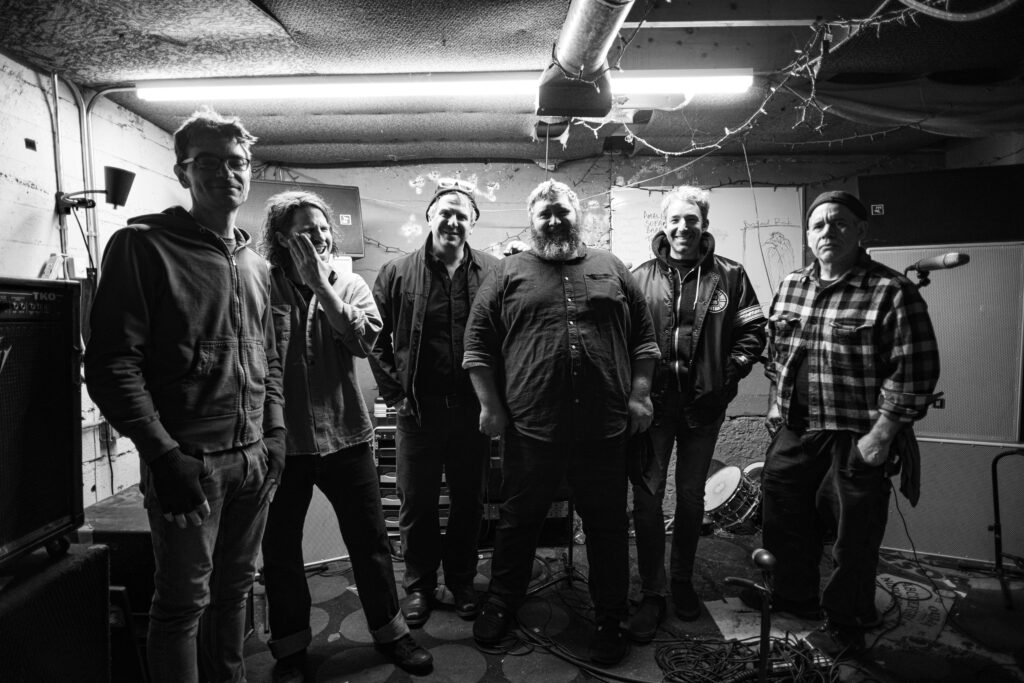
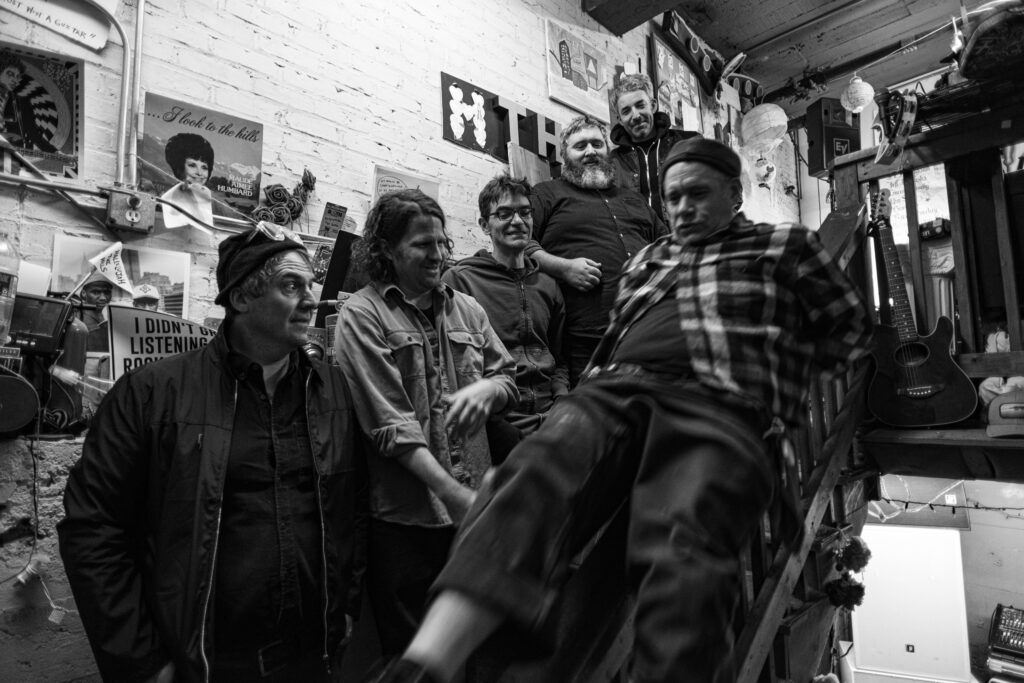
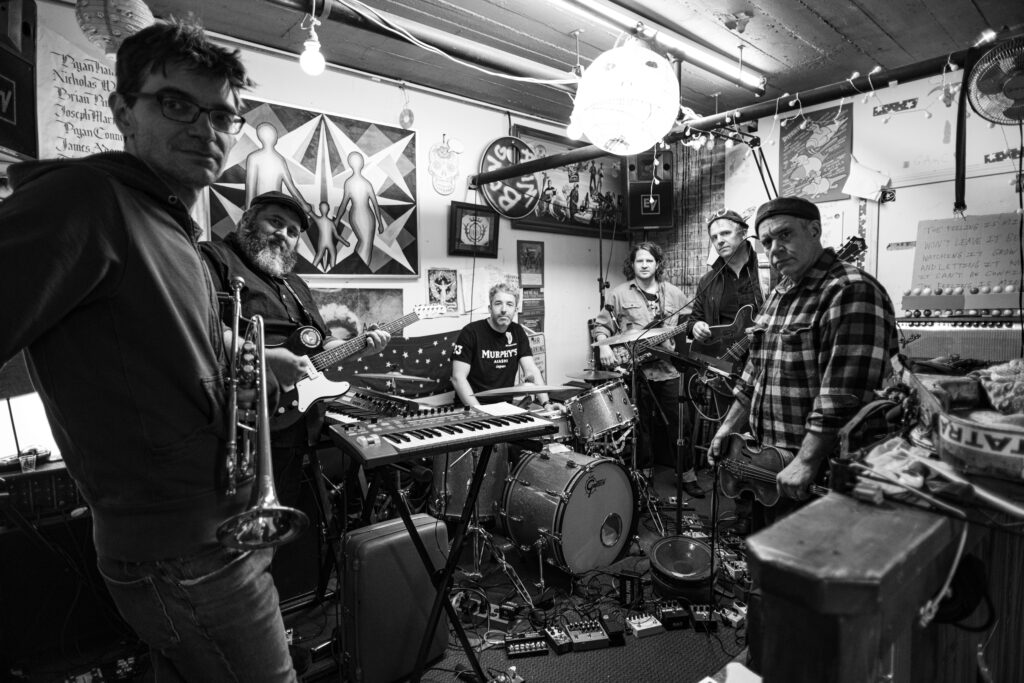
Charlestown, MA. November 3, 2025. Hallelujah the Hills in their rehearsal space. Left-to-right: Brian Rutledge, Joseph Marrett, Ryan H. Walsh, Nicholas Ward, Ryan Connelly, David Michael Curry. Photo by Harry Gustafson.
I don’t think I trust a band that rehearses in a clean, well-organized space. There’s a character to clutter. Look at the art studios of someone like Francis Bacon. So when I meet up with Ryan Walsh outside the Charlestown space where Hallelujah the Hills rehearses, I’m relieved when it’s glorious chaos. Gear everywhere, old furniture piled with past props, posters lining the walls (a blown up print of Jim Marshall’s iconic photo of Johnny Cash giving the finger during a performance at San Quentin Prison catches the eye).
For a band, 20 years of life feels like a century. For every group that hits the two decade milestone, there’s probably 50 that never made it out of their moms’ basements. While Hallelujah the Hills have mostly ironed out the kinks in the operation at this point, those first couple of years saw plenty of ups and downs, including inconsistent lineups, especially when it came to holding down a drummer. “We had someone quit onstage in the middle of a set,” bassist Nick Ward explains. “There’s a recording of it.”
The prescience of Spinal Tap aside, Hallelujah the Hills has been a pedestal of Boston’s indie scene since 2005, when Ryan Walsh was still playing in a group called the Stairs. While the name has caused some mild confusion (“There are people that think we’re a Christian band,” says Walsh), it’s stuck. For the better part of the last 15 years, the lineup has stayed consistent with Walsh (guitar/vocals), Nick Ward (bass/guitar/piano), Joe Marrett (bass/guitar/all sorts of things), Brian Rutledge (trumpet/trombone), Ryan Connelly (drums), and David Michael Curry (viola).
Walsh and Marrett smoke outside the rehearsal space while we wait for the rest of the band to pour in one-by-one. It’s early November, which means it’s dark at 6pm and just warm enough to not be too uncomfortable to be outside at night. They start taking me through the lore.
Over the years, they’ve picked up allies and collaborators from all over. This writer’s first awareness of the group came from their appearance on Titus Andronicus’ 2009 The Monitor, a punk-rock-opera rife with Civil War imagery. “We got paired together in Chicago,” Walsh explains. “It was like the first band we’ve been paired with on a tour that I just thought was amazing and loved. We became fast friends.”
Fast forward 20 years to the day of the first show that they performed at Great Scott, they’re celebrating the band’s birthday at Deep Cuts in Medford on November 15th.
Riding the coattails of their latest album Deck, which the band released this past summer, they’ll be performing a career-retrospective set. While Deck’s release show featured only songs from the recent release, the 20th anniversary will be a career-retrospective. Any album is fair game.
Photo by Harry Gustafson
At 54 songs, Deck stands as the band’s largest work. And while a 54 track concept album might at first seem daunting, Walsh and co. did what they could to make it more digestible to listeners. First of all, it’s subdivided into four regular sized albums, each styled after one of the suits in a deck of cards. Each suit has a distinct mood (for example, Hearts is more on the romantic side).
The band also encourages listeners to participate in the album’s sequencing by offering a customizable option: grab a deck of playing cards, pulls 13 cards at random, a make a playlist with the Deck songs that correspond with those cards. Ten of Diamonds? That’s “Samantha, You’re the Only Mistake I Know How to Make.”
It seems simple, but as Walsh acutely points out, this playlist methodology means that listeners can craft an entirely unique and personalized album experience. According to Google, there are about 635 billion different combinations possible by using this method. Even if you pulled all the same cards as the next person, it’s highly unlikely that they’d be in the same order.
The idea for the album has been in the back of Walsh’s mind for at least as long as Hallelujah the Hills has been a band, but never really got around to. He assumed that by the time he’d get around to making it, someone else would already have done it. But when it came time for the band to write and record a follow-up to their 2019 album I’m You, Walsh pulled the concept off the shelf and ran with it.
There’s some other cool elements to the album, like the joker songs, which are two instrumental tracks that the band released into the public domain. This idea was to encourage listeners to record their own vocals over the tracks. Deck’s about interactivity, after all. “We wanted to do something big and ambitious,” Walsh says, “but also signal like, this is not a chore. However you engage with it is great in our opinion.” After he says, Ward arrives at the space and we move the talk inside. The rest of the band soon falls in.
Writing and recording a 54 track concept album demands a lot of yourself as a songwriter and of your fellow musicians. While no recording process is entirely smooth, this monumental endeavor didn’t weigh too much on the band. Walsh was productive, writing fervently in his downtime and delivering at least one new song to the band’s sessions each week. Once they had enough material that they could divide into four categories (13 songs per suit plus two jokers), Deck was ready in about two years. There are bands that take longer to produce less.
Photo by Harry Gustafson
Deck also features collaborations from many of the friends they’ve picked up along the way. “Time to call in that favor from 13 years ago,” Walsh joked with Titus Andronicus frontman Patrick Stickles during the recording sessions. The band also enlisted help from Sad13 of Speedy Ortiz, Craig Finn of the Hold Steady, Clint Conley of Mission of Burma, Tanya Donnelly, Ezra Furman and more to round out the album’s cast.
While the response to the album has been positive, Ward does take a minute to grind his gears about one pet-peeve. “A lot of write-ups have called it a gimmick,” he says, laughing at the difficulty of recording 54 songs. “I feel like if you come up with a gimmick, it should have made things easier for you. If it made it harder, that signals you were trying to do something.”
Walsh adds that it’s more of a gimmick for bands to break up and get back together. “You get free press on it on each move when you quit and when you get back together,” he says. “So I think bands should quit, break up all the time, keep getting back together until no one will write about it.”
In all that time, songs are born and grow and change at almost the same rate as the folks who wrote them. Walsh looks back on some of the lyrics he wrote on the first couple albums with incredulity. “I feel like with a lot of your lyrics in the early days,” he says, “I didn’t really know what you’re singing about.” Looking back now, he has to create his own little meanings for what might have been running through his head 20 years ago.
At one point, as they’re setting up to rehearse, Walsh asks Ward how it feels to have been part of the group for the past 20 years. “Dude,” he replies, “it makes me feel old.”
Check out Hallelujah the Hills’ 20th anniversary show on Saturday 11/15 at Deep Cuts in Medford.
There was an early show at the Royale on the 24th and usually, that’s a welcome thing for most. However, Sofia Isella put on a set that felt like a disservice to cut short; Isella put on her Iinstagram story a few hours before the show that a few songs would have to be cut in order for the venue to get ready for another show. Despite the changes, the performance was one to remember for fans of the newcomer.
Isella’s support for the show was Alyeen Valentine, a Berklee-alum who came out in a bejeweled gas mask and black veil. Valentine released an album early last year, little rainbows after death, which was featured during the majority of the set. The performance was haunting, production-heavy, and powerful. Just like Isella, Valentine showed that she was a multi-talented artist. She bopped between her guitar, a beatpad, and the microphone to rely on a backing track as little as possible.
Shortly after Valentine left the stage, it was time for Sofia Isella. The 20-year-old Renaissance woman quite literally slid onto the stage with energy that would make one think she’s been doing this for years. She launched into her newest single, “Out in the Garden,” and crawled around the stage with her long hair masking her face. Isella’s movements were violent and emotive, which matched the essence of her lyrics. Her EP, I’m camera, addresses the struggles of womanhood, technology, and intimacy by combining beautiful vocals with horror-esque lyricism. Her live act mirrors the EP to perfection.
Another big feature of the set was Isella’s crowd interaction. There were many moments where she went into the crowd and grabbed hands with eager fans. Towards the end of the set, Isella crowdsurfed to a raised platform at the back of the venue and sang into the faces of onlookers. There was no separation between the artist and the crowd. It felt like she was on our level, no ego, no hierarchy. The encore was a second performance of “Hot Gum,” a fan favorite. Isella hopped into the crowd and joined her fans in a dance party to end the night. With Isella just being announced as Florence + the Machine’s East Coast opener on the group’s upcoming tour, it’s clear that she’s on the rise and that this intimate show may have been a rare gem.
October 15, 2025, Gigi Perez performs at the House of Blues in Boston
On her At the Beach, In Every Life headline tour, Cuban-American artist Gigi Perez made a stop at Boston’s House of Blues. The stage was covered in flowers, and behind her were visuals straight from her album, hand-drawn black-and-white sketches that felt soft and child-like.
Perez played a mix of old and new songs, from her recent hit “Sailor Song” to “Sometimes (Backwood),” and the energy in the room was electric. Fans sang along, danced, and cheered. It was the kind of night where you could feel the music vibrating through the entire crowd, exactly what you’d expect for a sold-out show from such an incredible artist.
Between songs, she opened up about grief and losing her older sister, and you could feel how much of herself she pours into every lyric. She also shared a story about being at Berklee six years ago, coming to this same venue to see FKA twigs, failing an ear training class, and wishing she could play here one day. You could tell how emotional she was onstage during this full-circle moment. The whole room went quiet, hanging on every word.
She even covered a Lana Del Rey song, completely making it her own by adding her delicate, emotional touch in her iconic deep voice. Gigi Perez is one of those rare artists who makes everything feel real and intimate, like she’s singing directly to you. By the end of the night, it was clear that her At the Beach, In Every Life tour is not just a performance, it’s an experience, a journey through deep emotions and pure artistry.
October 1st, 2025. Jasmine.4.t performs at The Rockwell in Somerville.
On October 1st, fans packed into the back room of The Rockwell in Somerville for an intimate performance by Jasmine.4.t and her band. Just after finishing a tour across the U.S. with Lucy Dacus on the Forever Is A Feeling Tour, Jasmine.4.t has garnered a new batch of fans. With the release of the deluxe version of her album You Are The Morning, a headline tour was certainly in high demand.
The band took the stage in front of a trans pride flag tacked onto the backdrop and immediately descended into a fan favorite: “Skin on Skin.” Much of the show featured many first-time performances of deluxe-exclusive tracks, including “I Can’t Believe I Did This Without You” and “Did U No,” which the band was ecstatic to play for the audience. Jasmine.4.t continually thanked the crowd for their presence, remarking about how exciting it was to get to play the deluxe tracks after they’d been officially out in the world.
During songs like “Woman” and “Please Can We Hold Each Other Yesterday,” the whole room seemed to go still as Jasmine.4.t knelt before the crowd, baring her soul through each lyric. Everyone held their breath in awe, not wanting to disturb the vulnerability in those moments. Alternatively, the crowd cheered and thrashed their heads during upbeat, guitar and percussion-heavy performances of “Elephant” and “Guy Fawkes Tesco Dissociation.”
Although the show was inherently intimate in its numbers, the quality and nature of the band’s performance made the show feel even more special and important. The band consists entirely of trans folks, and they proudly point this out throughout the show. The queer joy and camaraderie between the band and their audience burst out of the room. The band’s passion, vulnerability, and talent shone through in their Boston performance, surely leaving the audience with feelings of hope and happiness.
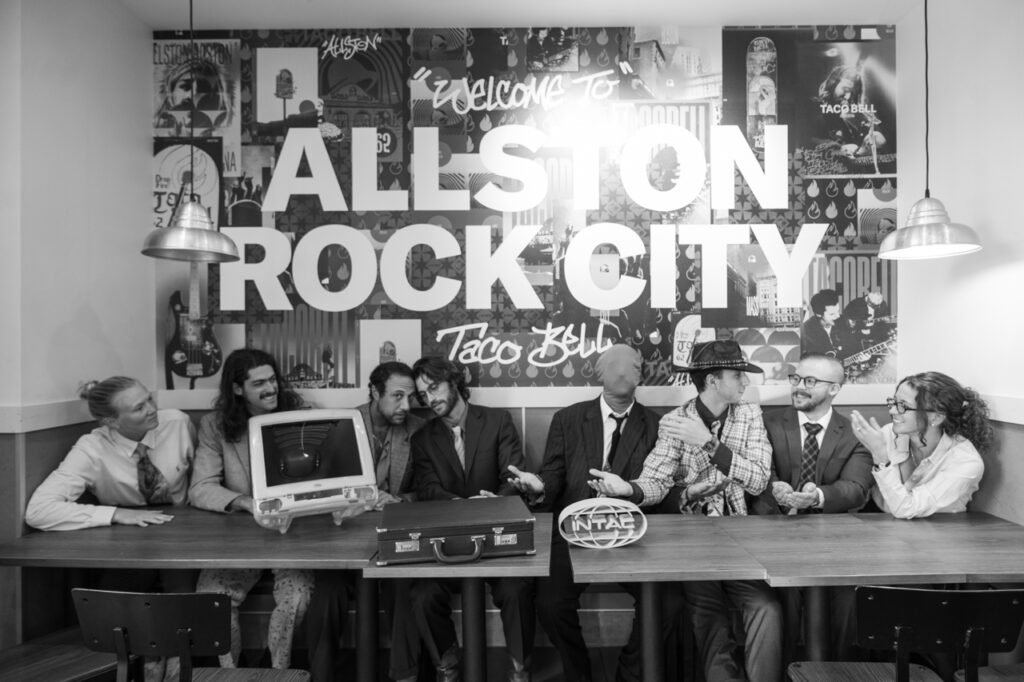
I am carrying a half-gallon jug of red wine from a freight elevator to the center of a converted warehouse loft. Scattered on the floor are drum heads, endless tangles of instrument cables, and a shopping bag full of water guns. Here, in an industrial corner of Charlestown, the band Intac prepares for their next concert.
The word “concert” is mine; Intac refers to this evening as a “Q2 Review.” I ask Bill Restivo, lead singer and creative engine of the band, why this event in mid-October is billed as a review of Q2. “In here it’s always Q2,” he tells me. Not too many indie rock bands would dare to measure time this way, or even know what fiscal quarter we’re in, but that’s exactly the grindset mindset that the cast of characters in Intac delights in sending up.
The last fourthmeal
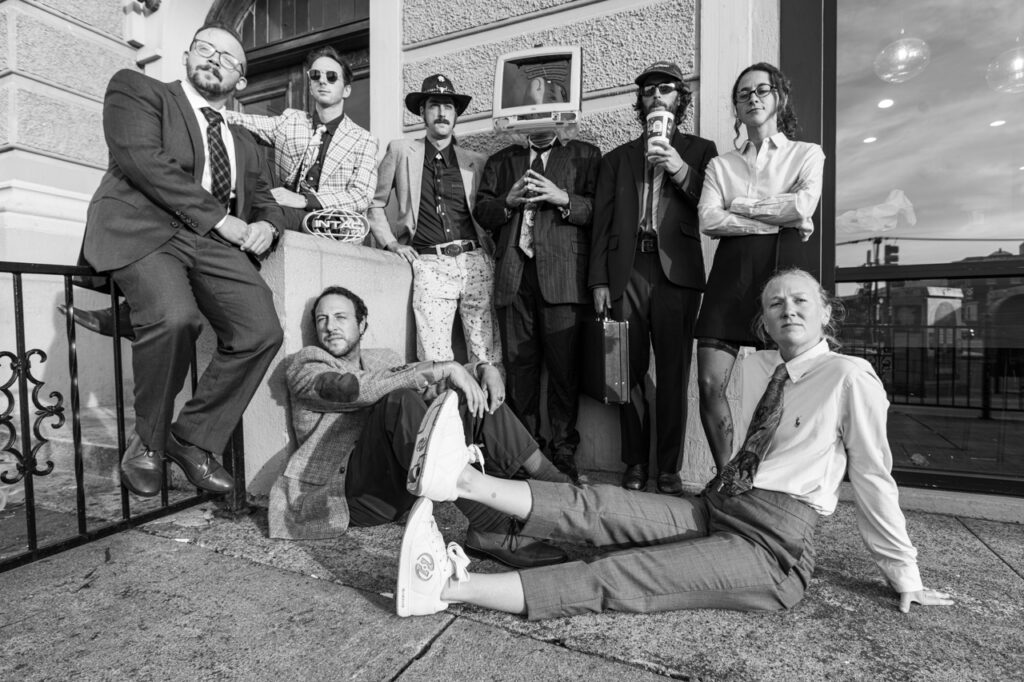
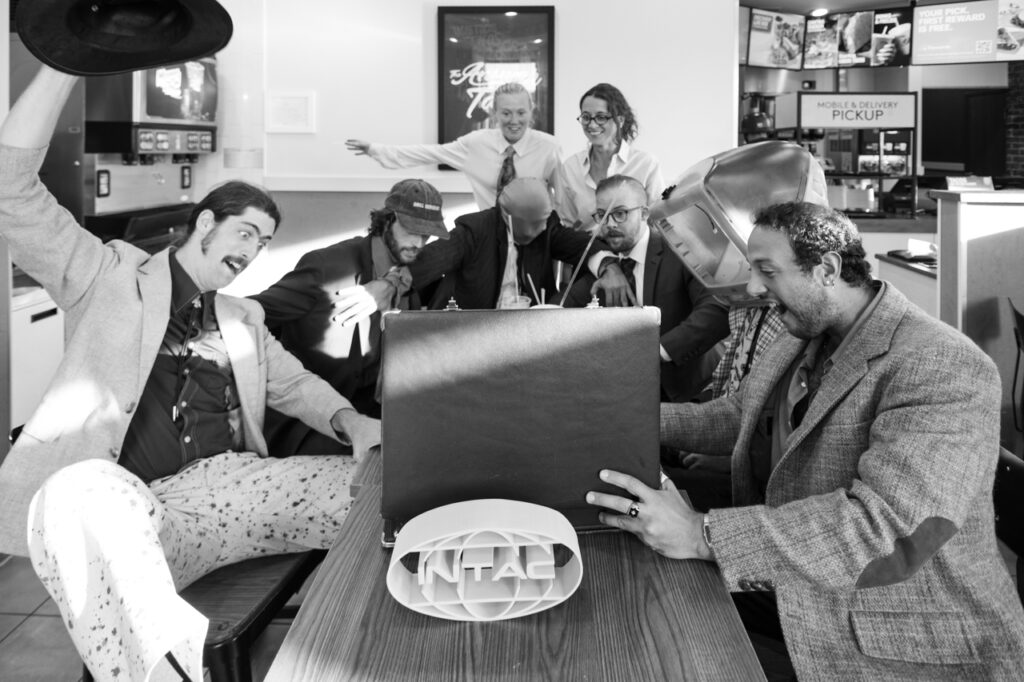
The Somerville-based small business (read: band) has been turning heads with a string of innovative products (read: polished garage-pop releases) and a compelling live act that’s part TED talk, part rock show, part anticapitalist performance art piece. Their signature corporate cosplay is enough to reel in curious onlookers online and at their seminars (read: shows) before going in with the hard sell (read: some of the most fun rock n’ roll tunes this side of Ric Ocasek).
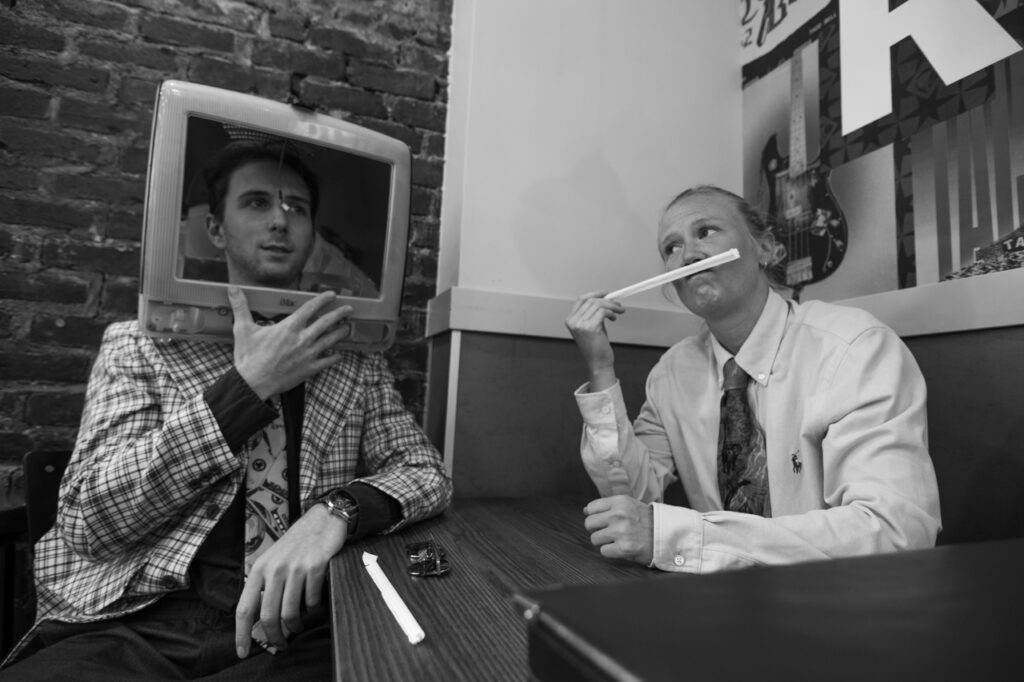
If you wandered into an Intac show, the first thing you’d see was a bizarro PowerPoint presentation projected onto a pop-up screen piloted by a man in a green Lycra bodysuit with the shell of an iMac G3 on his head. That’s Lucas Restivo, Bill’s cousin and creative foil. The two grew up part of a tight-knit Italian-American family. Bill’s parents split up when he was a baby and his dad moved from Woburn to Burlington to be closer to his brother’s family, their houses literally across the street from one another. “We’ve kinda always spent a lot of time at each other’s houses our whole lives,” Bill said. Before long Lucas and Bill became like brothers, creating art and their own antic sense of humor together.
To be a member of Intac is to be in on the joke. Josh Rosenberg, a childhood friend of the Restivos, has been playing music with Bill and Lucas for over 20 years. Early projects Never Say Die and Donna Bummer were mostly short-lived larks, “before business was the priority,” Rosenberg said. Now, he’s completely invested in Intac and wants to take the band as far as it’ll go. “We’re going to be the first business to hold a seminar on the moon,” he said.
In a corner of the loft, Neil Morrissey, member of the band The Only Humans, unfolds a green casino mat onto a table. Though he has his violin with him, his role in Intac is to run the blackjack table. “Bill likes to create this image of a seedy kind of business, or a business that’s in league with some shady people,” he said. This totalizing vision of the extra-musical world, an eye for what happens both on stage and off, is usually reserved for the biggest pop stars, not small-time indie bands. Everything is considered, from the water cooler that holds Bill’s mic stand to the oversized suits the band wears onstage. “In terms of the local live shows that I’ve seen, there’s nothing quite like it,” Morrissey said.
Intac has a way of turning spectators into fans. The combined might of their theatrical presentation and impressive musical chops sends audiences scrambling for their phones to capture some of the magic. Still, their live antics can sometimes overshadow their intentions as a band. “We’ve probably been too funny a few times and we know sometimes when you cross that line you feel like too much of a clown,” Lucas said. While humor and stagecraft are part of the Intac experience, they worry that people will see them only as a schtick. “We don’t want people to leave being like, ‘Oh that was fun and funny, but it’s a gimmick and I have no interest in listening to this music,’” Bill said.
Drummer Nick Morrone came to Intac first as a fan of the music before being recruited as a member. Morrone, who also plays in Me In Capris, thinks the synthesis of flash and substance is what makes the band special. “So many bands take themselves way too seriously and don’t write good songs. Which there are, unfortunately, a lot of those bands.” he said.
While an Intac live show might be something of a sensory overload, their recorded output is–perhaps unexpectedly given the artifice surrounding it–tastefully pared down and tender. There are no skits, no self-indulgent prog suites, no meme-bait. Bill demonstrates a remarkable (and marketable) pop sensibility in his songwriting which carries the torch handed to him by greats like Warren Zevon, Loudon Wainwright III, Josh Tillman, and other songwriters that paint with humor a mostly bleak portrait of the world.
Since 2021, Intac has been releasing catchy, clever garage rock and bedroom pop records at a steady clip. Their latest album and fourth original release of 2025, God Is Time, Time is Money, and the Money’s Long Gone, pushes their sound further into folk territory. There are road-weary ballads, hard-times lamented over acoustic guitar strumming, and paeans to the workweek. They haven’t quite gone country, but there’s a strong gesture towards twang and the lovelorn feelings that come with it.
The songs are more valuable to Bill than anything else Intac does, and I mean that literally. Part of his mission with the band is to challenge the streaming-era notion that recorded music is essentially worthless, a commodity cheaper than sugar or natural gas. “If there was an understanding that you get what you pay for and that [a] recording is worth money, then when you make good stuff maybe it has a higher chance that you could make money from it,” Bill said. It inspired the band to launch their Patreon channel and remove their music from streaming services.
Following a raucous performance of the Counting Crows’ “Mr Jones,” the lights in the loft suddenly come on. The apartment’s primary resident gets on the mic to announce that the cops are here. Sure enough, four Boston police officers are standing in the hallway. Apparently there’d been a noise complaint–even bohemians need their sleep it seems. The officers are quiet at first but soon start shining flashlights in people’s faces and phone cameras (including my own) and telling everyone to clear out. The party is over. It’s time to go home. In a statement posted to Instagram the next morning, the band offered the cops a deal: “show Intac proof of resignation from your post, and we’ll give you a FREE ticket to our holiday party at Margaritaville on Dec 6.” We hope to see some of them there.




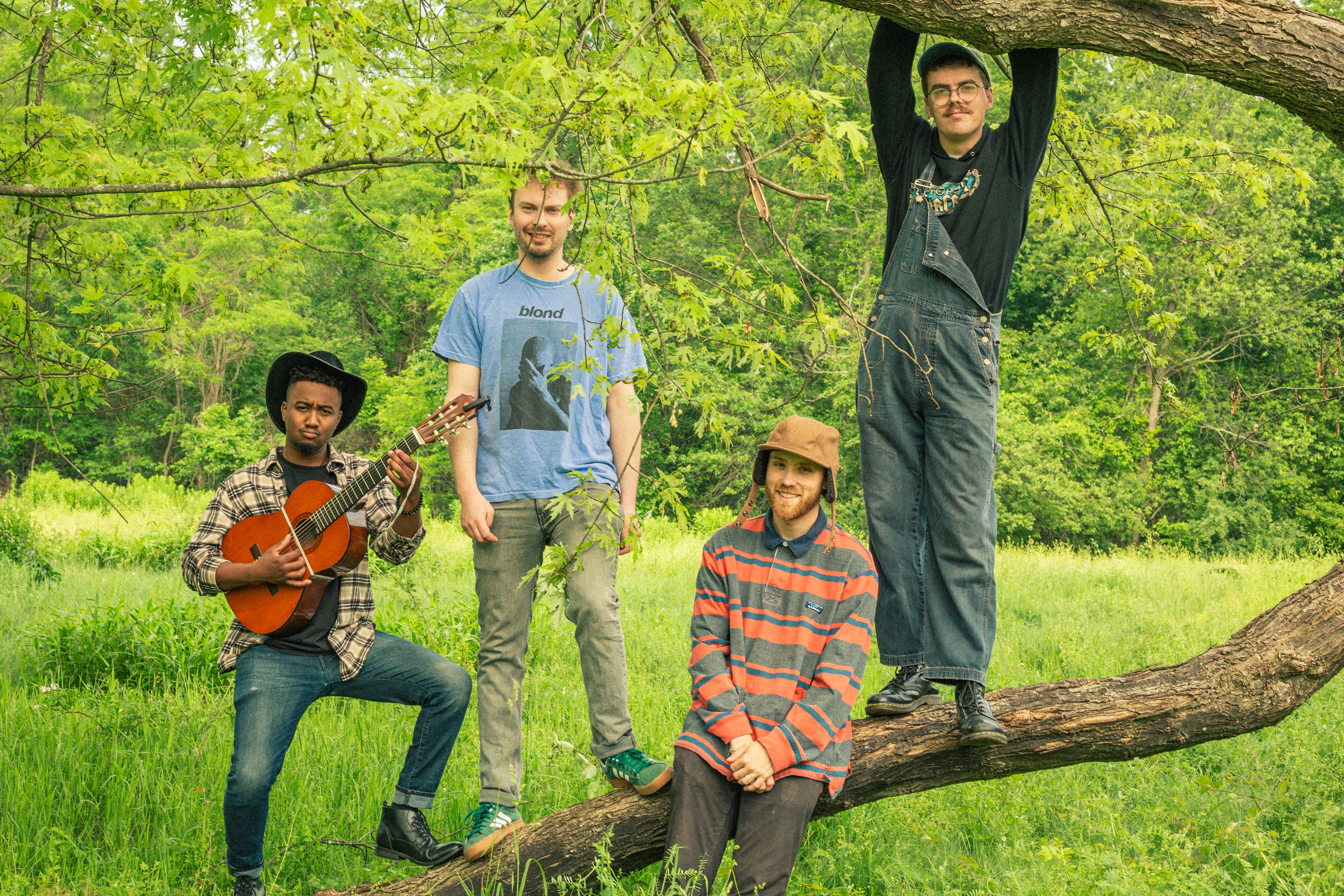
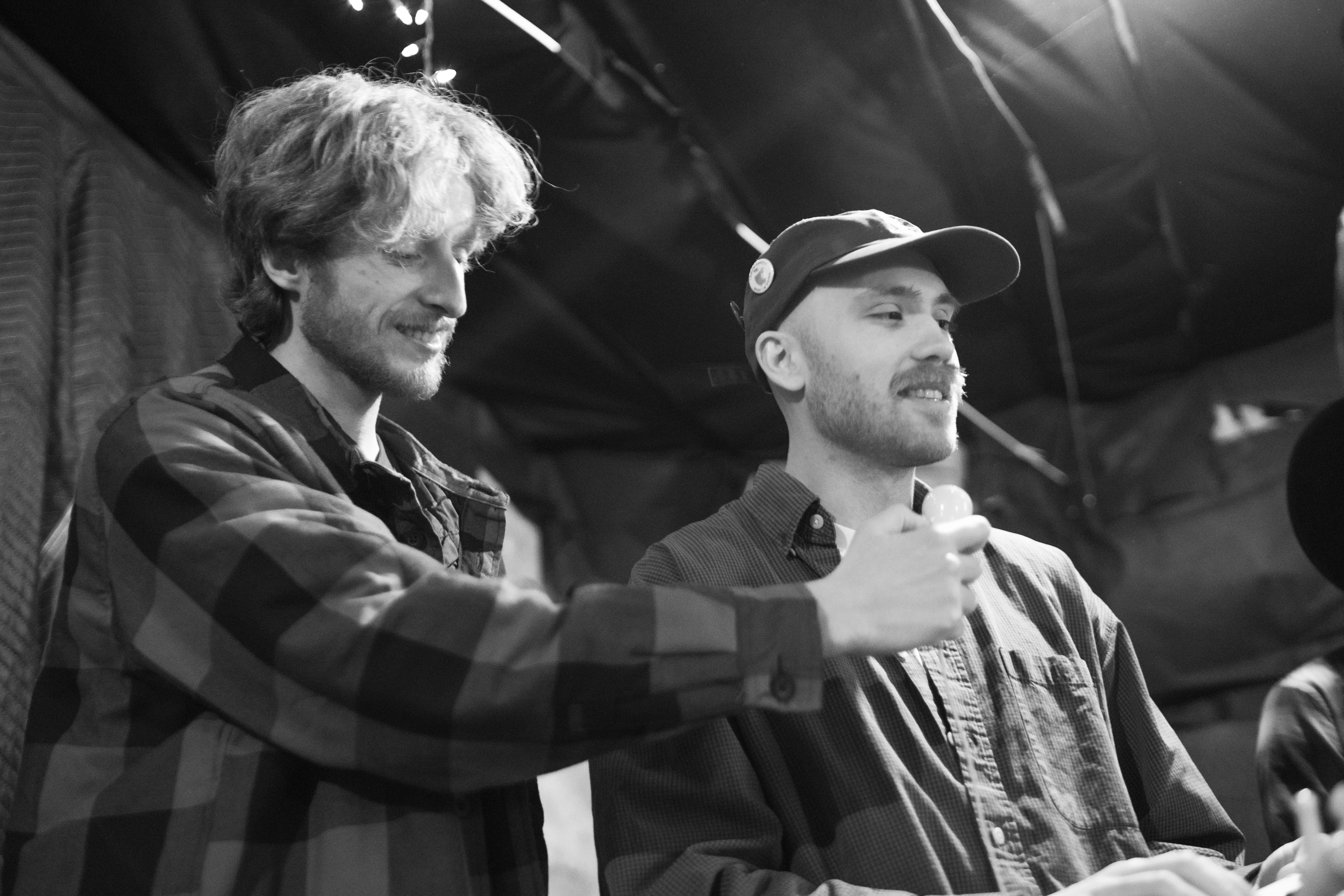
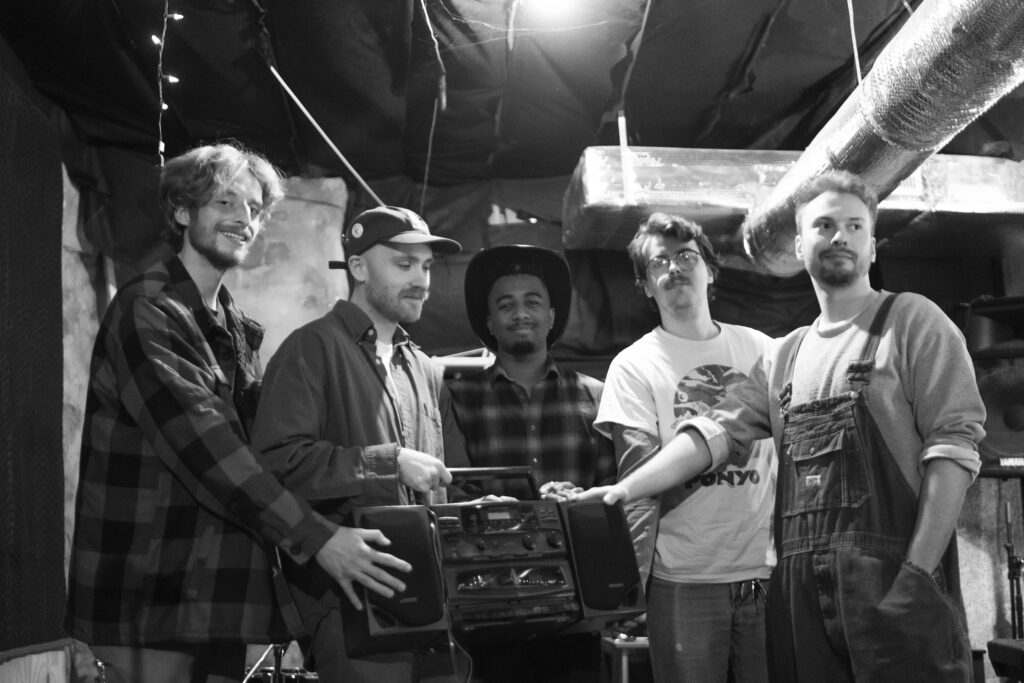

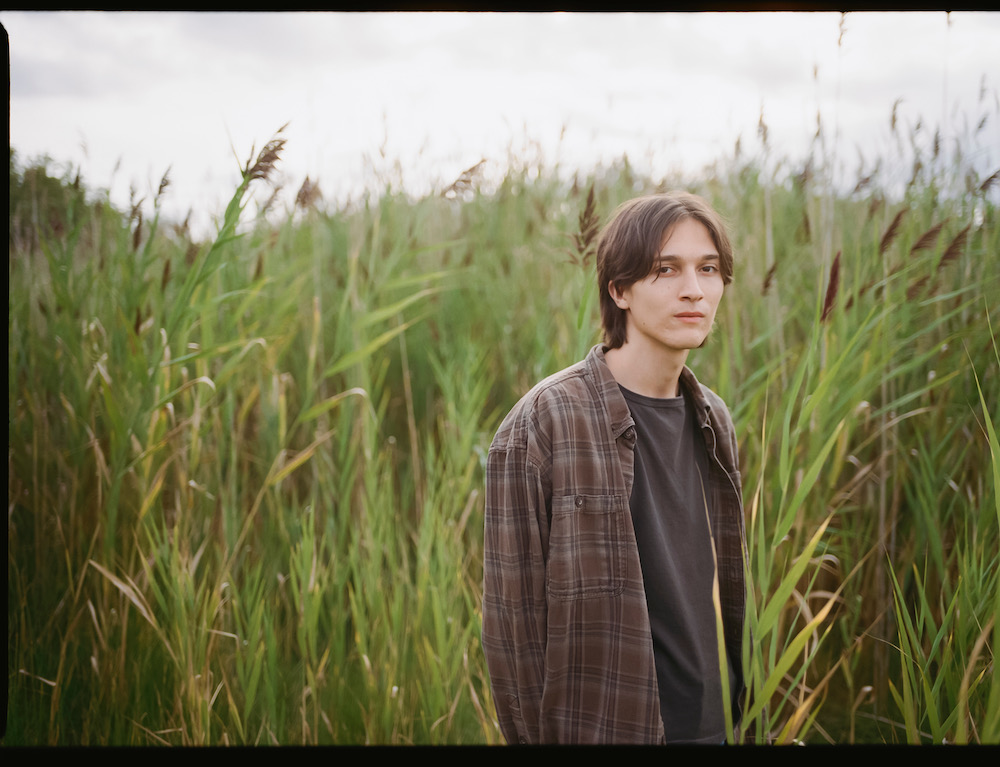 Number One Babe’s Alex Cholewa photographed by Derek Delahunt