
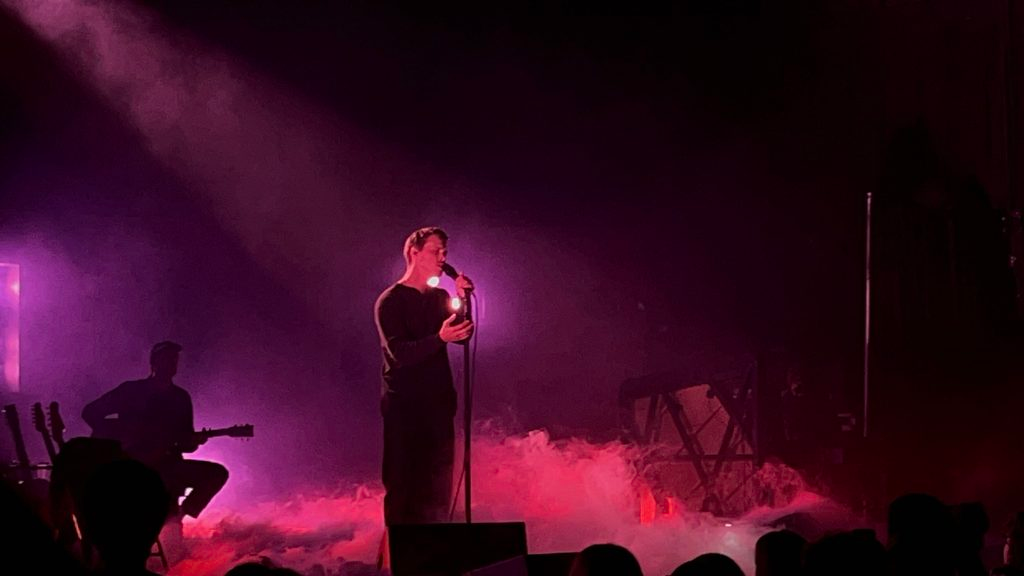
For an artist boasting a Grammy Award-winning songwriting credit for Beyoncé’s Cowboy Carter, production nods with Brockhampton, and other collaborations with Tyler, the Creator, Kevin Abstract, Jack Antonoff, and Clairo, Ryan Beatty is a surprisingly unassuming and modest guy. At least that’s how it felt Friday night at the House of Blues, when he came out waving in a simple dark hoodie and carpenter pants, immediately sat down in a folding chair in the shadowy part of the stage, and proceeded to fold a paper airplane. For fans of Sweet Fortune, the newest album by the Clovis, California-bred and L.A.-based singer, the paper airplane motif is well-understood lore. From album promotion teasers on social media to the music video for the breakout single “Secret Language” it’s become a part of this era. In the video, which Beatty describes as a metaphor for a long-distance relationship with his partner, he chases a paper airplane across the United States through thunderstorms and rainbows. There is a sweet simplicity, sense of wonder, and playful earnestness to Beatty’s work, complete with the arms-wide-open proclamations of devotion present on many of the tracks that carries over into his public appearances.
Despite releasing his first EP in 2012 and orbiting around the Radio Disney teen pop crowd, Beatty’s big entrance into the indie music scene came through his work with Brockhampton in their prime years of 2017-2019. His vocals are heavily featured on several of the now-disbanded group’s most popular songs like “BLEACH”, “QUEER”, “NO HALO”, and “SUGAR” and he also wrote for both Brockhampton and founder Kevin Abstract’s solo work. Beatty’s first full-length album, Boy in Jeans leaned heavily into the late-2010s “bedroom pop” and alternative R&B aesthetic, with production, lush instrumentation, and hazy vocals reminiscent of Frank Ocean, earlier Troye Sivan, and Miguel. Exploring Beatty’s queerness and the intersection of infatuation and religion through the lens of a closeted and ashamed gay coming-of-age narrative, the album definitely feels like a moment in time, and one that (at least in retrospective interviews) Beatty doesn’t recall especially fondly. The album’s lyrics are bold and at times jarring, almost as if to speak his feelings of queer longing and questions of purpose into existence was the goal of the project in its own right.
Flash forward to 2020: Beatty released Dreaming of David two months before the nationwide lockdown from the pandemic. Regarded as a more experimental, lo-fi album, the collection’s prominent autotune and modulated vocals, synths, and electronic production feel very closely linked to Beatty’s work on Brockhampton’s GINGER, the group’s last truly commercially and critically acclaimed project. This is my least favorite of his four full-length albums mainly because I think the sonic experimentation neglects his voice. Many of the songs feel sparse, while a few –– such as the slow-build, ethereal “Casino” which remains one of my personal favorites from Beatty’s catalog –– lean into the more intimate and somewhat ‘traditional’ indie pop songwriter formula. Beatty himself has noted he “used to be afraid of the pop label” associating it with those Radio Disney days or superficial music that lacks emotional depth. But with expansive language and a myriad of ways to portray different forms of love, the newest album in particular feels well-suited for interpretation and accessibility.
With 2023’s Calico: a wistful, cinematic, and deeply personal collection of songs, Beatty’s lyrics are equal parts melancholic and tranquil. The album features some of his best writing, a more stripped-back sound, and an intimate portrayal of a breakup and its subsequent period of meditative self-reflection amidst unanswerable questions about grief and desire. On “Bruises Off The Peach,” the singer croons, “There you go again with all your needs / What did it ever have to do with me?… Love will always last / Love will always hold me down / What is it all about?” lamenting the lingering wounds from a painful relationship. The fact that Beatty’s lyricism has grown so much over the course of his discography is a testament to the artist’s devotion to the art of the song as a unit of measurement for big emotions and powerful –– if sometimes heart-wrenching –– dynamics with family members, lovers, and his own music. On his latest record the songs are so well-crafted that the project feels like a work of art, a love letter to romance and sacrifice and the rewarding tenderness of being vulnerable with someone, but with more maturity than his previous work.
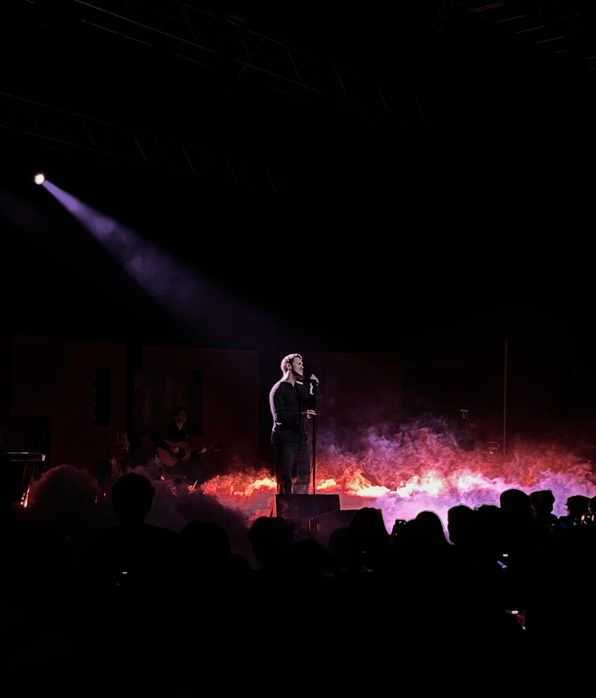
On Sweet Fortune, Ryan Beatty goes above and beyond what one might have come to expect from him, while simultaneously presenting himself as a deeply humble and private person. I’m always struck by artists who treat their live performances as a cathartic ritual for themselves, appearing, at times, to forget the rapt audience before them and instead sink into the trance-like state that only pure passion for music can encourage. He is one of those artists who visibly loses himself in the music in a way that can only be described as spiritual. And the sonic range featured on the album reflects it, too, as it pays homage to ‘60s and ‘70s folk-leaning songwriters like Joni Mitchell, Harry Nilsson, and James Taylor, while also embracing Beatty’s soulful side with nods to gospel and easy listening oldie hits. For a singer with such a raw, honest, and poetic approach to songwriting, it can be easy to feel like you “know” the artist on stage or even wish for them to disclose more about their personal life or reveal their true personality. While he is plenty charismatic and grateful and conversational –– after the opening song, Beatty chuckled coyly, “Boston… This is going to be fun” –– there seems to be something about the 31-year-old artist that is tucked away, guarded to keep some layer of his music private.
In other interviews surrounding the release of Sweet Fortune, Beatty has described the project as his most joyful one to date, referring to it as a ‘love album’ and hoping the music can speak for itself and feel relatable to listeners. In contrast with the pervasive melancholy of Calico, the declaration of optimism and affection rings true: Beatty leans into earnestness and adoration, coating the album in a cinematic sheen that blends old-soul country with contemporary indie pop perfection. One of the standouts from the album, the overture-of-sorts “Phantom,” encapsulates this theatrical, laid-bare side of the songwriter, questioning “Is it everything you wanted?” against a sweeping backdrop of strings. Here, he once again executes the vision of a deceptively simple song imbued with an almost magical ability to capture images with his lyricism. Throughout the concert, during which he performed Sweet Fortune in its entirety, Beatty took frequent breaks during the band’s solos to experience the music for himself, retreating to the same chair shrouded in darkness, billowing smoke, or a single spotlight, and closing his eyes as if listening to a hymn.
After a short but tender cover of Willie Nelson’s “Summer of Roses” and multiple bashful acknowledgments that talking during his shows was still a nerve-wracking part of his life, Beatty returned triumphantly for a three-song encore before the night closed. Writing about the pain and sacrifice that comes with letting someone into your world is by no means new ground for songwriting, but behind Beatty’s lush vocals and a guarded, sensitive public persona are layers of genuine yearning that complement his confessional and recurring motif-laden writing style. Embracing folk, soul, pop, and pure, controlled vocals that feel influenced by jazz and blues oldies, Beatty’s music sonically reflects the nuance of modern relationships. Before his final song at Friday’s show, the singer bowed, turned the applause towards his band, and stood with his hand on heart for several minutes, ending with, “Thank you Boston, I really enjoyed myself.” Struggling to conceal his wide grin in front of more than 2000 adoring fans, you can tell that he truly means it.